7 October 2026 | 10 min read
People Pen Desk
The city’s most famous pandals rise and fall in ten days, yet the true heartbeat of Durga Puja in Kolkata runs much deeper than scaffolding, paint and electric lights. It pulses through rituals so precise, so layered with meaning, that some of them unfold in whispered Sanskrit while the crowds outside remain entirely unaware anything is happening at all.
Walk past the glittering facades and you’ll see it differently. The Puja isn’t about spectacle arriving suddenly- it’s about presence arriving gradually, through intention, through soil, through fire, through the simple act of a flower being held in a devotee’s trembling hand.
Here are the ten moments that make Bengali Durga Puja not just a festival, but a living conversation between earth and sky, between the human and the divine.
Every Durga idol begins with earth. But not just any earth, earth chosen with intention, six days before anyone even knows the festival has started.
1. The Sacred Soil and the First Gaze
Each year, the artisans of Kumartuli follow a tradition that has survived for centuries. They walk into the oldest quarters of Kolkata- the areas society has always kept at distance and they ask a simple question at certain doorsteps.
They are asking for Punya Mati- sacred soil from the doorstep of a sex worker’s home
This soil taken from the threshold where society has drawn its sharpest line is then mixed into the clay used to sculpt the Goddess.
The philosophy is radical. By including soil from places and people that society has declared impure, the Goddess becomes inseparable from those very people. The divine mother is not pristine and separate. She is made of the earth beneath the feet of those whom society rejects. She belongs to everyone especially to those whom everyone else has pushed away.
It’s a theological statement dressed as a ritual.
But the practice has changed. The tradition is not uniform across all Durga Pujas in Kolkata today. Some committees collect it; others have moved away from it. And significantly, conversations with sex workers themselves have raised questions about how the tradition is being carried out whether it is truly honoring them or simply using their participation as symbolic gesture without addressing their lived reality.
This matters. The ritual’s meaning depends on genuine respect, not hollow symbolism.
Mahalaya: The Day Before the Goddess Arrives
On Mahalaya- a day that falls six days before Durga Puja officially begins something happens in Kumartuli that transforms clay into presence.
Mahalaya is the ancient marker of Devi Paksha, the fortnight of the Goddess, when she is believed to begin her journey to earth. Before dawn across Bengal, people wake to the broadcast of the Mahishasura Mardini- a recitation from the Chandi scripture that is older than living memory.
But in Kumartuli, as the city listens to those ancient chants, something more intimate happens.
Chokkhu Daan: The Painting of the Eyes
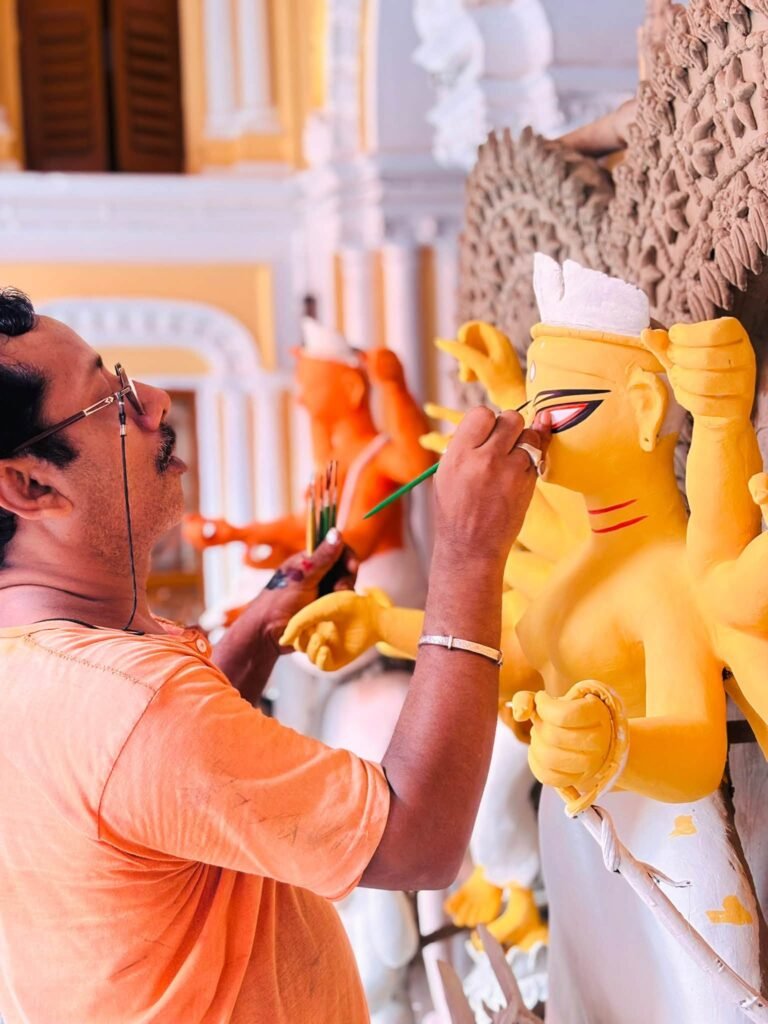
On Mahalaya morning, in the workshops of Kumartuli, the master idol-makers perform Chokkhu Daan- the painting of the Goddess’s eyes. Only the most senior artisans are permitted to do this. It is not a decorative act. It is a consecration.
Before Chokkhu Daan, the idol is a completed sculpture. After it, the idol is alive.
The brush touches clay. Two eyes appear. And in that moment, the Goddess is believed to be infused into the statue, to wake up, to begin seeing. UNESCO has recognized this as one of the truly consecrating acts in the entire Puja tradition not because it is dramatic, but because it marks the precise threshold where object becomes deity.
Those eyes that now gaze out from the clay face they are painted on a form made partly of soil taken from the doorsteps of people society has forgotten.
Six Days Later, the Public Celebration Begins
Mahalaya passes quietly for most of the city. The workshops close. The idols are transported to pandals. And six days later, on Shashthi, when the crowds pour out and the lights ignite and the dhaak drums first sound across Kolkata, most people believe the Puja is just beginning.
But those who know the rituals understand the truth: the Goddess already arrived. She woke up six days ago, in the quiet of a workshop in Kumartuli, when an old artisan picked up a brush and painted her eyes open.
2. Bodhon: When the Goddess Wakes Up
Shashthi morning arrives differently in Kolkata than anywhere else.
On Maha Shashthi, as daylight fades and the dhak drummers take their positions, the Bodhon ceremony unfolds at dusk across pandals in West Bengal. This is the formal awakening and invitation of the Goddess into the temporary structure built for her worship.
During Bodhon, the priest performs Pran Pratistha- the ritual of instilling life force into the idol through specific mantras and ceremonies. This is the moment when the clay sculptured by master artisans in Kumartuli transforms from inanimate matter into a living deity in the eyes of devotees. After this rite, the face of the goddess is unveiled to the public for the first time, and crowds surge forward to catch their first glimpse of the idol.
The evening also includes Kalparambha and Amantran- rituals that formally invite the Goddess and invoke her protective presence. With Shashthi evening, the city’s mood shifts from anticipation to reverence. The festival has officially begun.
3. Nabapatrika: The 9 Lives
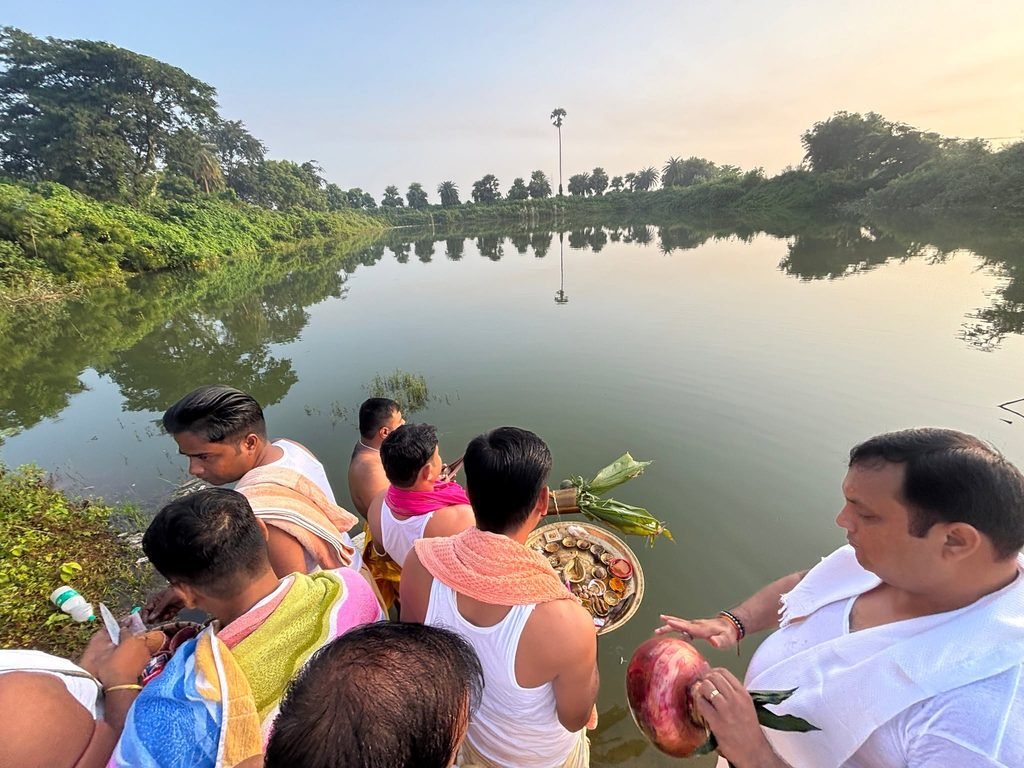
On the morning of Maha Saptami, devotees gather at riverbanks and tanks across Bengal to perform one of the most ancient rituals of Durga Puja the bathing of the Nabapatrika. The Nabapatrika is a bundle of nine plants, each representing one of the nine forms of Durga.
The lead plant is always the banana tree, Kola Gaach revered because bananas symbolise fertility and sustenance. The nine plants are threaded together using twigs of the aparajita (climbing asparagus) plant and nine bunches of yellow threads, then the entire bundle is dressed in a new yellow silk sari as if preparing a bride for her journey. This dressed bundle is called Kola Bou, the “banana bride.”
At dawn, as the first rays of the sun strike the earth, conch shells sound across the water. The nine plants are ceremonially bathed with waters drawn from eight different holy places and sanctified sites. This bathing, known as Maha Snan, mirrors the coronation ceremony of a king in classical texts the magnitude of the ritual underscores its spiritual weight. Throughout the bathing, priests chant different mantras for each of the nine goddesses, accompanied by varied musical instruments creating a soundscape unique to each form.
After the ritual, the Nabapatrika is installed in the pandal beside Lord Ganesha. This installation, called Prana Pratishtha on Saptami, completes the awakening that began on Shashthi evening. The nine plants remain there, growing throughout the five days of worship, a living symbol of the Goddess’s agricultural and nurturing powers.
The Nabapatrika tradition itself predates the formal Durga Puja ceremonies by centuries. Agricultural communities performed this ritual independently to appease the gods for good harvests; when Durga Puja became the dominant festival, the Nabapatrika was woven into its fabric, carrying forward an older memory of fertility rites that spoke to Bengal’s agrarian soul.
4. Kumari Puja: The Divine Child on Maha Ashtami
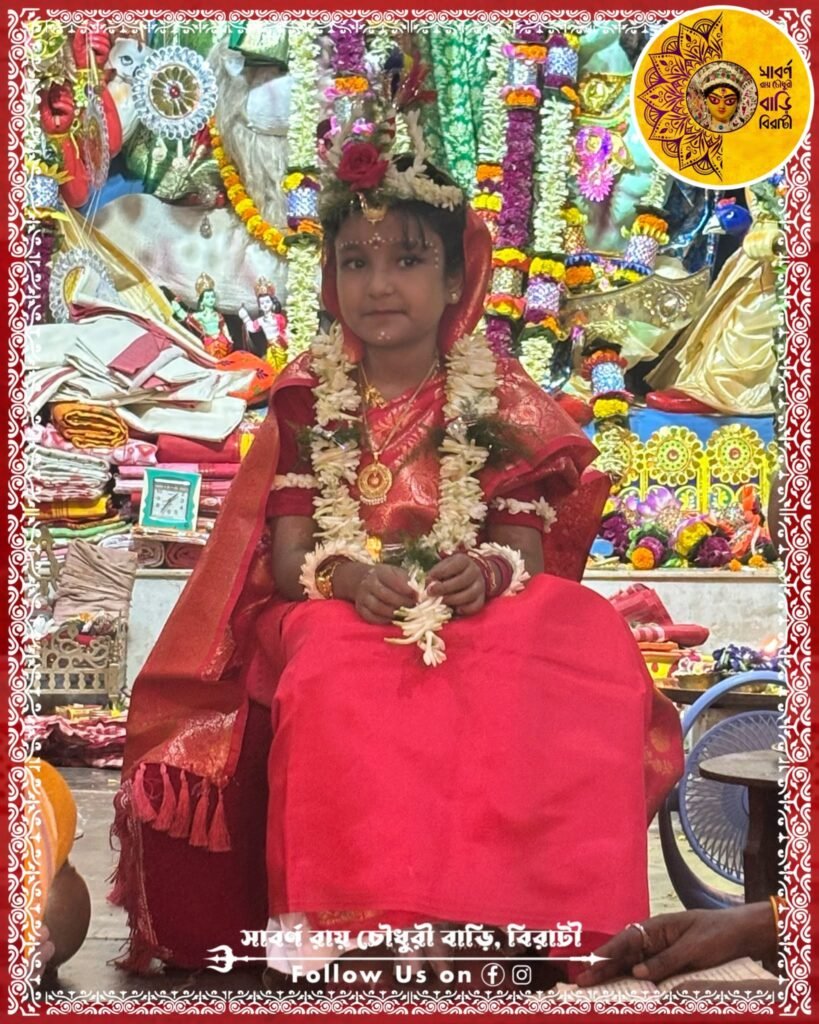
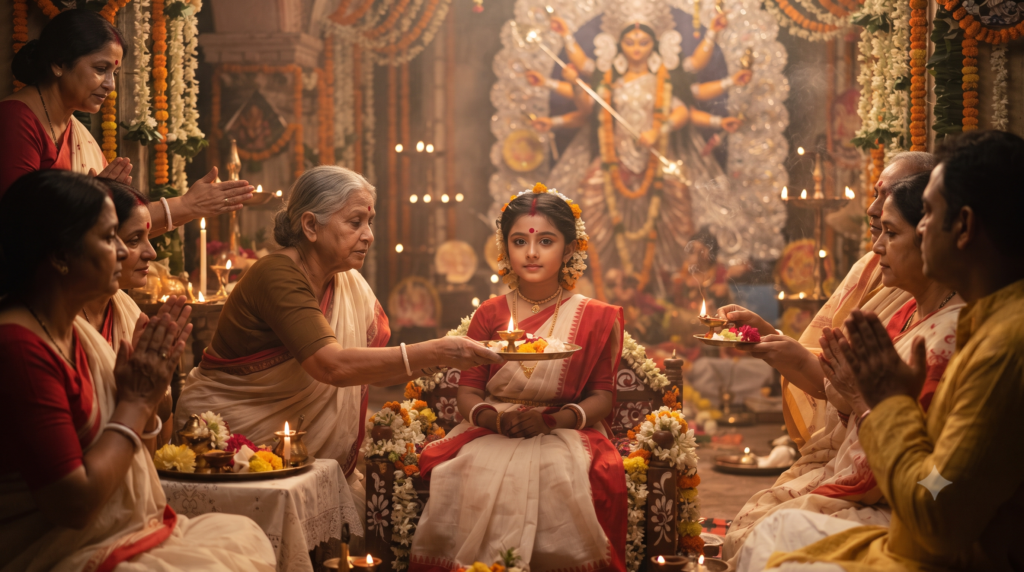
Maha Ashtami dawns with a ritual unique to Bengal’s expression of Durga worship the Kumari Puja. Pre-pubescent girls, typically aged between 2 and 10 years old, are invited to homes and pandals to be worshipped as living incarnations of the nine forms of Durga.
In West Bengal, this tradition is specifically and unmistakably an Ashtami ritual, distinguishing Bengal’s observance from other regions of India. The ritual was initiated in its modern institutional form by Swami Vivekananda at Belur Math in 1901, though the veneration of young girls as divine has ancient roots in tantric Hindu philosophy.
The ceremony begins with the washing of the girls’ feet- an act of profound respect and humility. Devotees pour water over their feet and gently dry them, a gesture that reverses the normal hierarchy and honours the purity and innocence that the girls embody. The girls are then seated on a raised platform or chowki as the priests chant mantras specific to each girl’s designated age form.
Each age carries distinct symbolic meaning. A two-year-old represents Kumari, the goddess of peace and prosperity; a six-year-old is Kalika, invoked for victory over enemies; a nine-year-old embodies Durga herself. The ritual culminates with the offering of special bhog often khichdi (a rice-lentil preparation), labra (mixed vegetables), and a milk-based sweet which the girls receive as blessed food.
The girls fast through the day until the puja is complete, and many devotees believe that the Goddess herself inhabits these young forms during the ceremony, making the act of worship not symbolic but a direct communion with the divine feminine in its purest state.
5. Sandhi Puja: The Exact 48-Minute
The most precisely timed ritual of all Durga Puja is Sandhi Puja the junction ceremony performed at the exact seam between Ashtami and Navami. In 2026, this window opens from 10:27 AM to 11:15 AM on Monday morning, 19 October, lasting exactly 48 minutes-24 minutes in the final throes of Ashtami tithi and 24 minutes after Navami begins.
The mythological moment Sandhi Puja commemorates is extraordinarily fierce. As the armies of the demon Mahishasura press their attack on Durga during the climax of the battle, two generals named Chanda and Munda rush at the Goddess with unmatched ferocity At that instant, a fiery light blazes from her third eye, and from that light emerges Chamunda- Durga’s most fearsome and powerful form. Chamunda strikes down the two demons in an instant, and the tide of the entire war turns.
This transformation from the composed, warrior-like Durga to the frenzied, blood-thirsty Chamunda is remembered and ceremonially honoured during those 48 minutes. Devotees fast from the beginning of Ashtami through the end of Sandhi Puja. The offerings made are elaborate: 108 lotus flowers are presented, echoing the 108 names of Durga found in the Devi Mahatmya.
Priests recite the Devi Mahatmya portions of the sacred text that recount the Goddess’s battles and the air in the pandal becomes thick with devotional intensity. There is a hush that falls over crowds during these 48 minutes, a stillness in the midst of the festival’s noise. It is in this window, traditional wisdom holds, that the barrier between the human and divine grows thinnest, and wishes made with pure intention are granted with special grace.
6. Pushpanjali: The Ordinary Miracle
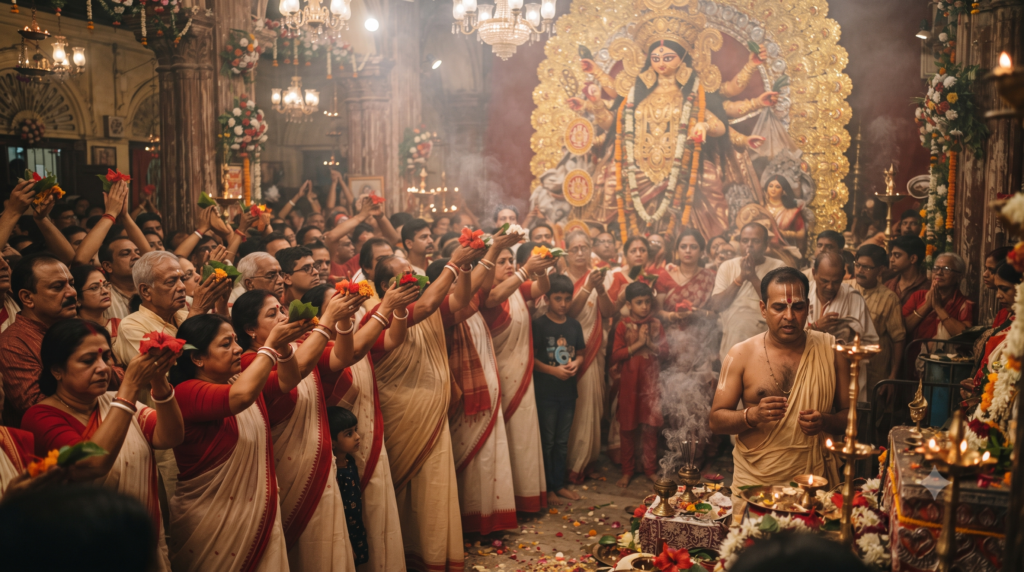
Pushpanjali- literally, an offering of flowers made with folded hands is performed across three days: Saptami, Ashtami, and Navami. However, Maha Ashtami holds special significance as the most auspicious day for this offering.
On Ashtami morning, batches of devotees approach the goddess idol with armfuls of fresh flowers marigolds, chrysanthemums, roses, and jasmine carefully selected and arranged. The flowers are often accompanied by betel leaves and sacred tulsi, offered with the chanting of the Pushpanjali Mantra: Om Jayanti, Mangala, Kali, Bhadrakali…
The ritual is a community event arranged at most pandals, with volunteers managing the flow of worshippers. At Belur Math, Pushpanjali begins early in the morning and continues in sequential rounds throughout the day. Many devotees maintain strict fasts on this day and break their fast only after offering Pushpanjali in the evening, making the act of flower-offering a culmination of their daily discipline and devotion.
Pushpanjali is also offered in the evening aarti across all three days, though the offering performed immediately after Sandhi Puja carries an even greater resonance, as the Goddess is understood to be in her most powerful and present form at that moment.
7. Dhunuchi Naach: When Smoke Becomes Prayer
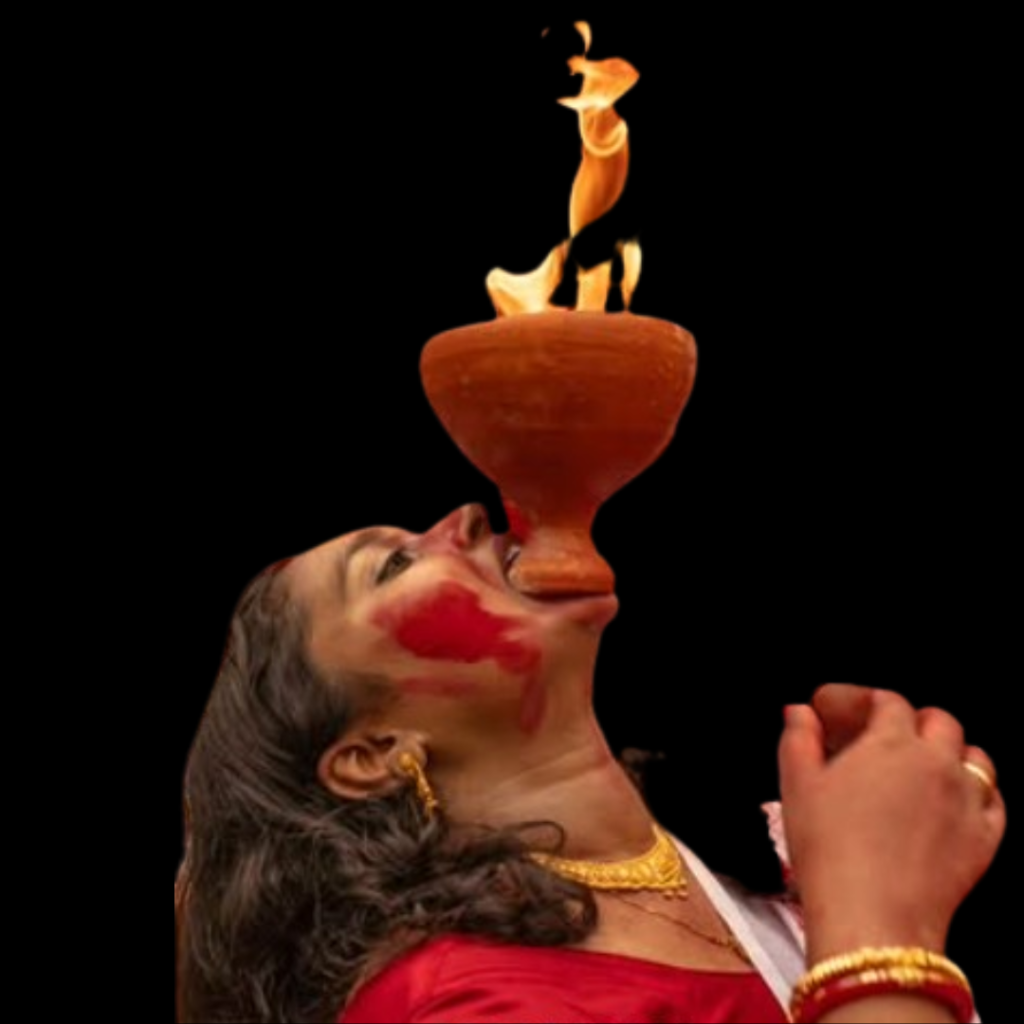
By the time Maha Navami arrives, the festival has reached an emotional crescendo. It is on this night particularly the late evening hours that one of Bengal’s most visceral and ecstatic rituals unfolds: the Dhunuchi Naach.
The Dhunuchi is an earthen censer, handmade by potters in districts such as Nadia and Bankura weeks before the festival. Into the base of the dhunuchi, burning charcoal is placed, which ignites a layer of slow-burning coconut husk. On top, incense resin (typically labdanum or frankincense) is sprinkled, and camphor is added for an intensely aromatic smoke.
Holding one or two of these burning dhunuchis aloft, devotees traditionally women, though in modern times men participate too begin to dance to the frenzied beats of the dhak drum. The dance is not choreographed; it is raw, ecstatic, and deeply spiritual.
Devotees sway and gyrate, the scent of incense enveloping them, the dhak’s hypnotic rhythm drawing them deeper into a trance-like state of devotion. Some dancers balance a dhunuchi on their foreheads or even hold it between their teeth, a display of strength and spiritual surrende at once. The smoke rises in thick clouds, filling the pandal, marking the prayers of thousands ascending skyward.
The Dhunuchi Naach originated in rural Bengal’s devotional traditions, though urban clubs and cultural organisations began conducting formal competitions for the dance from the 1950s onward. Yet despite modernisation, the ritual has retained its core function: it is an offering of oneself body, breath, and voice to the Goddess in her most powerful form. The young women particularly embrace this role, claiming the ritual as their own space within the broader festival.
8. Homa And Bhog: The Fire Offering And Community Feast
On Maha Navami, after the Dhunuchi Naach settles into quieter hours, the Navami Homa begins a grand fire ritual that constitutes one of the most elaborate sacrificial offerings in Hindu practice. The priest lights a sacred fire, and into it, he offers 700 verses from the Durga Saptashati (the sacred text recounting the Goddess’s battles) in the form of aahuti, or oblations.
With each verse, a measure of ghee, grains, or fragrant wood is placed into the flames, carrying the words and intentions of the community heavenward. At Belur Math, this Homa follows the Bhog Aarti the evening distribution of blessed food.
And indeed, the Bhog itself is a ritual as significant as any formal puja. Bhog is the sacred food offered first to the Goddess and then distributed to all devotees. On Navami, the Bhog traditionally consists of khichdi (a simple mixture of rice and lentils), labra (a vegetable medley), chutney, and payesh (a milk-based sweet). It is humble food, but prepared with devotion and received with gratitude.
The Bhog serves a social function as profound as its spiritual one. Across caste, class, and creed, everyone who attends the Durga Puja pandal from the richest family to the poorest labourer sits together to partake of the same Bhog from the same leaf plate. For five days, the Durga Puja pandal becomes a space where hierarchy is temporarily suspended, and community true community is enacted through shared food and shared worship.
9. Sindoor Khela: The Red Goodbye
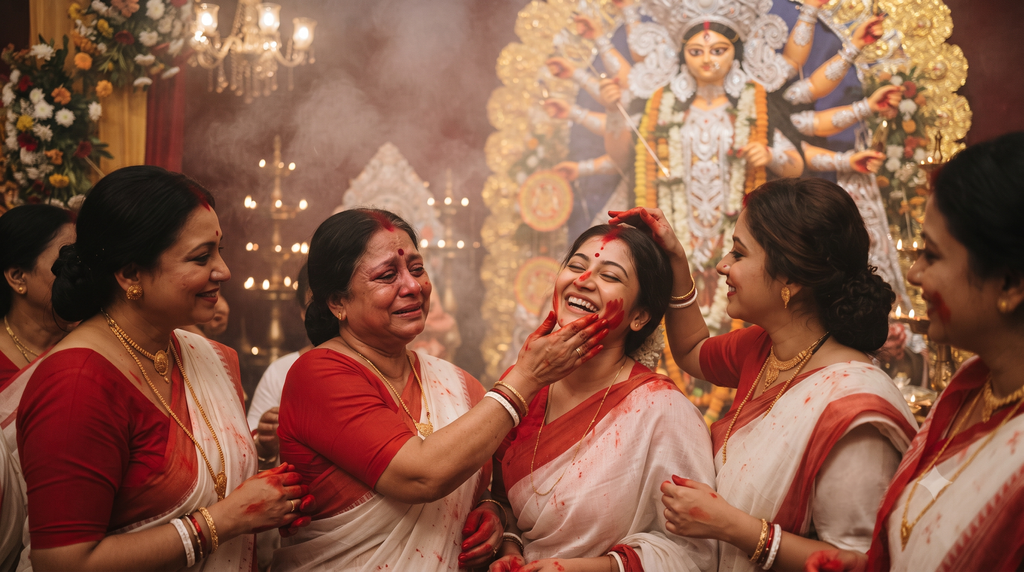
Dashami arrives, and the mood changes before anyone speaks.
The morning of Vijaya Dashami dawns with a ritual that belongs entirely to the women of Bengal- the Sindoor Khela, the vermillion game.
After the morning aarti and Pushpanjali, married women gather before the Durga idol dressed in traditional white sarees bordered with red. With reverence, they approach the Goddess and, using vermillion powder, mark her forehead and feet- a final act of worship before her departure.
They then offer her sweets and betel leaves. And then, the ritual transforms from solemn farewell to joyous celebration. The women turn to each other and begin playfully applying vermillion to one another’s faces, foreheads, and cheeks. They also apply it to the three sacred bangles that Bengali married women traditionally wear the shankha (conch), pola (coral), and noa (iron) making the vermillion a marker of marital status, resilience, and unity.
The Sindoor Khela carries multiple meanings simultaneously. It is an honouring of Durga’s married status for the Goddess departs this day to return to her husband, Lord Shiva, in the Himalayas. It is also a prayer: when a married woman applies vermillion to another woman, she is invoking blessings for her long life and marital happiness. And it is reclamation a moment when women claim joy, laughter, and community in the space that has been historically reserved for men’s participation in ritual life.
In earlier decades, Sindoor Khela was an exclusively married-women’s ritual, a fact that drew criticism for its exclusivity. In contemporary observance, the ritual has broadened to include all women unmarried girls, widows, and those of other faiths transforming it into an affirmation of womanhood itself rather than marital status alone.
10. Darpan Visarjan: The Last Mirror, The Final Waters
As Sindoor Khela concludes, the ritual centre shifts to the morning puja chamber where a ceremony of utmost delicacy unfolds: Darpan Visarjan, the mirror immersion.
A vessel of water is placed before the Goddess, and a mirror is positioned so that her reflection falls into the water. The priest then performs the ritual of immersing this reflection and with it, the divine presence that has inhabited the idol for five days departs. This is not merely symbolic: in Hindu ritual understanding, the moment Darpan Visarjan is complete, the idol transitions from being a living deity to being lifeless clay. Only after this point can the murti be touched and moved by human hands without sacrilege.
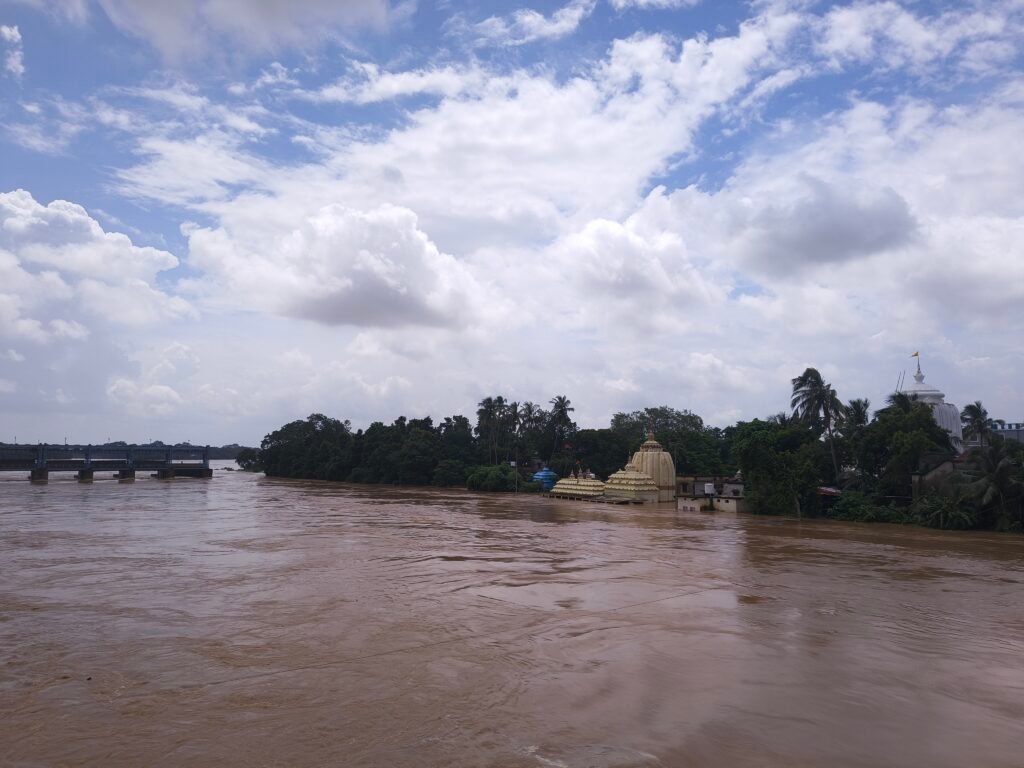
At riverside ghats at Outram Ghat, Babughat, and dozens of other sites across Kolkata and Bengal the actual visarjan procession unfolds in the late afternoon and evening. The idols, now lifeless clay, are carried shoulder-high to the water’s edge to the accompaniment of music, drumming, and chants honouring the Goddess.
Yet the ritual does not end in the water. After the immersion is complete, sacred water from the very spot where the idols were submerged is collected in a vessel and brought back to the pandal or home. This water, called Shanti Jal (water of peace), is sprinkled on the gathered family and community members, and the priest chants peace invocations three times. With this final act, Durga Puja comes to its close.
The five-day festival has ended, but the Goddess will return again next autumn. Until then, her absence is palpable and paradoxically, her presence is most deeply felt.
Why This Matters
When UNESCO inscribed Durga Puja on its Representative List of Intangible Cultural Heritage in 2021, it recognized something beyond festival logistics. It recognized a complete system of ritual, art, community participation and spiritual intention woven together so thoroughly that you cannot separate them.
Kolkata’s Durga Puja survives not because of its grand pandals or its celebrity visitors or its Instagram moments. It survives because these ten rituals and hundreds more layered beneath them continue to do what ritual has always done: make the invisible visible, make the distant intimate, and transform ordinary people into vessels of something greater than themselves.
The pandals may stand for only ten days. The rituals carry the memory much further.