14 October 2026
People Pen Desk
Durga Puja has already begun with Mahalaya, and Kolkata is now dressed for Maa. In the weeks before, clay idols were shaped in Kumartuli, bamboo frames rose on street corners, and the lanes filled with new lights every evening. There are thousands of pandals across the city, and this list brings you 100 of them, each with its own theme, its own committee and its own story. Pick a lane, grab a cup of tea and start walking.
For a long time, Durga Puja in Kolkata belonged to the bonedi bari, the old families of the city. These were royal, zamindar and merchant households who held the puja inside their own homes, usually in a thakurdalan, the open worship hall of the house. Many bonedi bari pujas still continue today, keeping the old rituals alive.
The barowari puja grew out of a different idea. The word means “twelve friends.” A group of neighbours would pool their money and work together to bring the goddess to the open street. The first one in Kolkata is usually traced to the Bhowanipore Sanatan Dharmotsahini Sabha, which began its puja at Balaram Bose Ghat Road in 1910. Soon many other neighbourhoods followed. Today, barowari pujas are spread across more than 3,000 pandals in the city. This article covers 100 of them.
1. Sanatan Dharmotsahini Sabha | Est. 1910 | South Kolkata
The Sabha opened its Durga Puja to the public in 1910, and many people count it among the earliest community pujas in Calcutta. Before that, the festival was mostly a private affair held inside wealthy households, where the family decided who could step into the courtyard. The Sabha changed that by bringing the idol out for anyone in the neighbourhood to see. Its first celebrations followed Vedic rituals, with the idol installed beside the Jora Shiva temple close to Tolly’s Nullah, near Kalighat. More than a century later, the puja still carries the same idea: that Durga Puja belongs to everyone who lives nearby, not only to one household.
Address: 45B, Harish Chatterjee Road, Jatin Das Park, Patuapara, Bhawanipore, Kolkata 700025
Nearest Metro: Jatin Das Park Metro Station or Netaji Bhavan Metro Station
Nearest Bus Stop: Mitra School Bus Stand (on Balaram Bose Ghat Road) or Bhawanipore Bus Stop (on Harish Mukherjee Road), both within 200 to 250 metres
2. Brindaban Matri Mandir | Est. 1910 | North Kolkata
Since 1910, Brindaban Matri Mandir has kept community Durga Puja going in the lanes of North Kolkata. Its celebrations follow age-old rituals, and for many families the arrival of Maa Durga is a yearly meeting point across generations. The beat of the dhak is often the first thing people mention when they describe the puja. The Mandir does not stop its work once the festival ends. Its welfare initiatives serve the wider community through the year, which is why many residents see the puja as part of a longer commitment to helping the people around them, and not just a few days of celebration.
Address: 6, Brindaban Mullick First Lane, Sukia Street, Machuabazar, Kolkata 700009
Nearest Metro: Girish Park Metro Station (Blue Line), about 0.72 km away. Shobhabazar Sutanuti Metro Station and Mahatma Gandhi Road Metro Station are also within reach.
Nearest Bus Stop: Sukia Street / Amherst Street Crossing Bus Stop
3. Shyampukur Adi Sarbojanin | Est. 1911 | North Kolkata
Shyampukur Adi Sarbojanin Durgotsav dates back to 1911 and is among the older community pujas of North Kolkata. Its roots lie in the Ramdhan Mitra Lane neighbourhood, where local residents came together to set up a collective puja. This was a period when the grand Durga Pujas of Calcutta were still closely tied to wealthy families and their homes. A neighbourhood committee that raised its own money and organised its own worship helped change that picture. The puja’s importance lies in this early stage of community worship, when the festival slowly began to belong to a wider public rather than a few households.
Address: 22, Ramdhan Mitra Lane, Shyambazar, Hati Bagan, Kolkata 700004
Nearest Metro: Shyambazar Metro Station (Blue Line), a 4 to 5 minute walk, or Shobhabazar Sutanuti Metro Station (Blue Line), a 5 to 6 minute walk
Nearest Bus Stop: Shyambazar 5-Point Crossing Bus Stop or Shyambazar A.V. School Bus Stop
4. Sikdar Bagan Sadharan Durgotsav | Est. 1913 | North Kolkata
Sikdar Bagan Sadharan Durgotsav was set up in 1913, when community-organised pujas were gaining ground across the city. It sits in the Hatibagan-Shyambazar belt and is one of the long-running public pujas that have kept the neighbourhood character of Kolkata’s festival alive. Its age is only part of its importance. As public pujas spread in the early twentieth century, residents could pool their resources and organise celebrations outside their own homes, and Sikdar Bagan is part of that shift. In recent editions the committee has taken up themes such as humanity, environmental destruction and the aftermath of natural disasters, while keeping its focus on the Durga idol and the devotional atmosphere.
Address: 1, Sikdar Bagan Street, Hatibagan, Kolkata 700004. Landmark: Near Town School / Hatibagan Crossing
Nearest Metro: Shyambazar Metro Station (Blue Line). The pandal is a 10 to 12 minute walk (800 to 950 metres) down Bidhan Sarani Road towards Hatibagan.
Nearest Bus Stop: Hatibagan Bus Stop (also known as Hatibagan Crossing) or Khanna Bus Stop
5. Adi Lake Pally | Est. 1915 | South Kolkata
Adi Lake Pally was established in 1915 and belongs to the early history of community Durga Puja in South Kolkata. At that time, collective worship was becoming a way for neighbourhood residents to meet each other outside the private household setting. The name of the puja is often linked with Subhas Chandra Bose, who is believed to have presided over some community puja committees of that period. That connection still needs archival confirmation, so it is best read as a tradition rather than a settled fact. Even so, the association makes the puja a useful stop for anyone exploring how Durga Puja and Bengal’s nationalist politics overlapped in the early twentieth century.
Address: Lake Place Road, Lake Market, Kalighat, Kolkata 700029
Nearest Metro: Kalighat Metro Station (Blue Line), about 450 metres, roughly a 5 minute walk
Nearest Bus Stop: Lake Market Bus Stop or Rashbehari Crossing (on S.P. Mukherjee Road)
6. Sarkar Bagan Sammilita Sangha | Est. 1917 | North Kolkata
Sarkar Bagan Sammilita Sangha traces its origins to 1917, in the same wave of neighbourhood pujas that shaped North Kolkata in the early twentieth century. The name itself gives a clue to how it works. Sammilita means united, and community pujas of this kind rely on shared participation and shared organisation rather than the resources of one family. Residents pool their efforts and time, and the celebrations bring people together through worship and cultural activities. The committee was also among those whose consent letter supported Kolkata’s Durga Puja nomination for UNESCO’s Representative List of the Intangible Cultural Heritage of Humanity. That letter was a backing for the nomination, not a separate UNESCO designation of the committee itself.
Address: 3/2 Nilmoni Mitra Row, Tala, Kolkata 700002. Landmark: Tala Railway Station
Nearest Metro: Shyambazar Metro Station, about a 750 metre walk
Nearest Bus Stop: Shyambazar 5-Point Crossing / Shyambazar Bus Stop
7. Bagbazar Sarbojanin Durgotsav | Est. 1919 | North Kolkata
Bagbazar Sarbojanin Durgotsav is among the most historically significant community pujas in Kolkata. It began in 1919 at 55 Bagbazar Street, at the residence of the Sarkar family, under the name Nebubagan Baroyari Durga Puja. When the family could no longer carry the celebration on its own, local residents pooled their contributions and kept it going as a community event. The puja later moved between places in the Bagbazar area and gradually became a formally organised institution. In 1926, social worker Nagendra Nath Ghoshal helped bring prominent citizens into the organisation, and by 1930 the exhibition had developed a stronger public and cultural role. That year, under Durgacharan Bandyopadhyay’s presidency, the exhibition promoted Indian-made goods and encouraged visitors to avoid imported British products, linking the festival with the Swadeshi movement.
Address: 78, Bagbazar Street, Baghbazar, Kolkata 700003. Near Bagbazar Launch Ghat (about 100 metres) or Bagbazar local railway station (about 150 metres)
Nearest Metro: Shyambazar Metro Station (Blue Line), roughly 0.8 to 1.2 km on foot
Nearest Bus Stop: Bagbazar stop on Rabindra Sarani or Shyambazar 5-Point Crossing, served by several local bus and auto routes
8. Tala Barowari Durgotsab | Est. 1921 | North Kolkata
Tala Barowari Durgotsab belongs to the tradition of community-organised Durga Puja in North Kolkata, where devotion and neighbourhood life meet in one shared celebration. The word barowari refers to a puja run by a group of people rather than a single family, and it reflects how public participation grew in Bengal’s Durga Puja tradition. The puja is rooted in the Tala neighbourhood and brings residents and visitors together through worship, community bonding and Bengali cultural practices. Over generations it has become part of the living heritage that shaped the city’s own style of Durga Puja.
Address: 23/2, Banamali Chatterjee Street, Kolkata 700002
Nearest Metro: Shyambazar Metro Station, the convenient access point for the Tala area. Belgachia Metro Station is another nearby option.
Nearest Bus Stop: Buses running through Shyambazar and the Bagbazar / B.T. Road routes serve the area, with stops close to Banamali Chatterjee Street and Tala Park. Tala Railway Station is the nearest local train station, about 370 metres from the puja.
9. Dharma Prasarini Samiti of Mukherjee Ghat | Est. 1922 | South Kolkata
Founded in 1922, Dharma Prasarini Samiti of Mukherjee Ghat is part of South Kolkata’s long tradition of community Durga Puja. Neighbourhood pujas like this one made the festival a shared public event rather than a private one. Local people came together for worship, cultural practices and shared work, and the puja became part of the neighbourhood’s identity. Its history follows the growth of community-organised Durga Puja in Kolkata, where worship of the goddess reaches beyond individual households and becomes an expression of local life. Over the decades the committee has kept that link between faith and neighbourhood alive, with residents taking on the work each year.
Address: Suhasini Ganguly Sarani, Patuapara, Bhowanipore, Kolkata 700025
Nearest Metro: Netaji Bhavan Metro Station or Jatin Das Park Metro Station, both on the Blue Line
Nearest Bus Stop: Hazra Crossing Bus Stop or Asutosh Mukherjee Road / Jatin Das Park Bus Stop
10. Tala Prattoy | Est. 1925 | North Kolkata
Tala Prattoy has a distinct place in Kolkata’s puja landscape because it treats the festival as a space for contemporary art. The organisers do not rely only on conventional decoration. They turn the pandal into an immersive artistic space, with experimental design, installations and visual storytelling. Visitors are invited to think about ideas, emotions and different readings of the goddess, rather than only looking at the familiar imagery of the festival. Artists and craftspeople play a central role in shaping the presentation, and the puja blends traditional practices with contemporary thinking. That combination has made Tala Prattoy one of North Kolkata’s notable destinations for theme-based Durga Puja.
Address: Manmatha Dutta Road (or 8/1, Rajkumar Chatterjee Road), Tala Park, Tala, Kolkata 700037
Nearest Metro: Belgachia Metro Station (Blue Line), about 600 to 900 metres, roughly a 9 minute walk. Shyambazar Metro Station is also nearby, about 1.2 km away.
Nearest Bus Stop: Tala Park Bus Stop
11. Simla Byayam Samity | Est. 1926 | North Kolkata
Simla Byayam Samity was established in 1926 and is part of North Kolkata’s community puja tradition. Byayam means physical exercise, and associations with that name were common in the early twentieth century. They were places where local residents gathered, learned discipline and built solidarity with each other. The Samity’s Durga Puja carries that community role into the festival and brings together religious observance and the cultural life of the Simla area. The puja’s legacy belongs to a period when sarbojanin Durga Puja was becoming a major part of the city’s public and social life.
Address: 9B, Singhee Lane, Abhedananda Road, Simla, Machuabazar, Kolkata 700006
Nearest Metro: Girish Park Metro Station (Blue Line), a 3 to 5 minute walk (170 to 400 metres)
Nearest Bus Stop: Girish Park Bus Stop or Beadon Street Crossing Bus Stop, along Chittaranjan Avenue and Abhedananda Road
12. Bakul Bagan Sarbojanin | Est. 1928 | South Kolkata
Bakul Bagan Sarbojanin Durgotsav started in 1928 and is one of South Kolkata’s long-standing community pujas, rooted in the cultural life of Bhowanipore. Over the years it has built a distinct artistic identity through its pandal design. Its themes have drawn on folk traditions, cultural memory and human experience, which gives the pandal a character beyond a place of worship. The puja belongs to the evolution of Kolkata’s community pujas, where neighbourhood participation and shared devotion became central to celebrating the goddess. By combining artistic expression with religious tradition, it has kept its place in South Kolkata’s Durga Puja landscape and connected generations of residents and visitors.
Address: 36, 1A, Rajshekhar Bose Sarani, Bakul Bagan, Bhowanipore, Kolkata 700025
Nearest Metro: Netaji Bhavan Metro Station (about 0.49 km, Blue Line) is the closest walking option, followed closely by Kalighat and Jatin Das Park metro stations.
Nearest Bus Stop: Jatin Das Park Bus Stop or Bakul Bagan Bus Stop. The area is easily reached by general Bhowanipore-bound buses and autos.
13. Sreebhumi Sporting Club | Est. 1930 | North-East Kolkata

Sreebhumi Sporting Club in Lake Town has become one of the city’s most widely recognised destinations for large Durga Puja installations. Over the years it has become known for monumental architecture, ambitious lighting and recreations of well-known Indian and international landmarks. In 2025 the club chose Disneyland as its theme, following earlier headline-grabbing presentations such as a Burj Khalifa-inspired pandal in 2022. For 2026 the theme is Hawa Mahal, Jaipur, which recreates the pink façade, the windows and the architectural rhythm of Rajasthan’s famous palace. The move from an international entertainment destination to a historic Indian landmark brings a different cultural reference into the club’s architectural spectacle. The challenge is less about copying a building than about adapting its forms to a temporary structure built for worship, public movement and illumination.
Address: 198, Canal Street, Sree Bhumi, P.S. Lake Town, Kolkata 700048
Nearest Metro: Belgachia Metro Station (Blue Line), or Central Park Metro Station (Green Line). Shuttle or auto options are available from Belgachia Gate 2.
Nearest Bus Stop: Sreebhumi Bus Stop (along Canal Street and the VIP Road area), with Lake Town and Bangur bus stops also nearby
14. Kumartuli Sarbojanin Durgotsav | Est. 1931 | North Kolkata
Kumartuli’s identity is closely tied to the artisans who make Durga idols for Kolkata and beyond. A puja in this neighbourhood has a special relationship with the making of the goddess, since visitors are never far from the workshops, clay, materials and skilled hands that shape the image before it reaches the pandal.
The 2026 theme, “Mon Diye Dekhun”, asks visitors to look attentively. The idea suits the place well, because making a Durga image depends on close observation of line, expression, proportion and detail long before the idol is placed under the festival lights.
Address: 8B, Abhay Mitra Street, Sovabazar, Kumartuli, Shobhabazar, Kolkata 700005
Nearest Metro: Shobhabazar Sutanuti Metro Station (Blue Line), a 5 to 7 minute walk (about 400 to 500 metres). Gate 2 or Gate 3 are the most convenient exits.
Nearest Bus Stop: Sovabazar / Jagat Mukherjee Park Bus Stop
15. Hindusthan Park Sarbojanin | Est. 1931 | South Kolkata
Hindusthan Park Sarbojanin Durgotsav was founded in 1931 and marks its 96th year of celebrations in 2026. Located in the Hindusthan Park area, it has built a reputation for mixing artistic imagination with themes rooted in society, culture and everyday human experience. The 2025 theme, Lokoj, explored indigenous and folk traditions, with particular attention to the Chadar Badar tradition of Adivasi communities. The presentation aimed to draw notice to customs that risk losing their connection with younger generations. The 2024 theme, Kalpo Ritur Golpogatha, offered an imaginative picture of a peaceful world free from war and conflict. Set side by side, the two themes show how the pandal has been used both to preserve cultural heritage and to voice wider hopes for society.
Address: 51/1, Hindustan Park, Gol Park, Gariahat, Kolkata 700029. Landmark: Opposite Basanti Devi College
Nearest Metro: Kalighat Metro Station (Blue Line), about 1.2 to 1.5 km on foot. A short auto or cab ride to Gariahat crossing is more practical.
Nearest Bus Stop: Gariahat Bus Stop or Golpark Bus Stop
16. Nalin Sarkar Street Sarbojanin | Est. 1933 | North Kolkata
Nalin Sarkar Street Sarbojanin Durgotsav is a historic community puja in the Hatibagan-Shyambazar area, known for its theme-based pandals. The committee has repeatedly used art to explore social questions and contemporary ideas. In 2025 the theme was Rupantor, or Transformation, conceived by artist Sanatan Dinda. It looked at the changing position and widening possibilities of women in modern society and presented women’s progress through the language of art.
In 2026 the puja has adopted Jalolipi, a theme centred on rivers, early civilisation and water pollution. It traces the relationship between rivers and human settlements and draws attention to the environmental damage caused by human activity. The move from Rupantor to Jalolipi shows how wide the committee’s concerns have been, from women’s roles to the environmental costs of modern development.
Address: Nalin Sarkar Street, Hatibagan, Kolkata 700004
Nearest Metro: Shyambazar Metro Station (Blue Line), about 800 to 850 metres (roughly an 8 to 12 minute walk via Gate 1 or Gate 4)
17. Hatibagan Sarbojanin Durgotsav | Est. 1934 | North Kolkata
Hatibagan Sarbojanin Durgotsav is a long-standing community puja on Sri Aurobindo Sarani, in a neighbourhood known for its traditional markets, old streets and festival culture. The puja has explored both folk traditions and human relationships through its recent themes. In 2022 the pandal presented Patachitra, the scroll-painting art, bringing folk artists, painted motifs and storytelling into the pandal to highlight the value of preserving indigenous art. In 2025 it turned to the Calcutta ghats and the river that has cradled the city for centuries. Earlier, in 2023, the theme was Doshar, meaning companion or partner, which explored emotional bonds, mutual support and the need for connection.
Address: 134, Sri Aurobindo Sarani, Hatibagan, Kolkata 700006
Nearest Metro: Shobhabazar Sutanuti Metro Station (Blue Line), about a 5 to 8 minute walk. Shyambazar Metro Station is also nearby.
Nearest Bus Stop: Hatibagan or Shyambazar 5-Point Crossing bus stops along Bidhan Sarani and Sri Aurobindo Sarani
18. Hatibagan Nabinpally Sarbojanin Durgotsav | Est. 1934 | North Kolkata
Hatibagan Nabinpally is one of the most prominent North Kolkata community pujas, known for turning Bengali literature, theatre and cultural history into immersive pandal experiences. In 2025 the theme was Amar Desh, Amar Durga, which honoured lesser-known women freedom fighters who took part in the Quit India Movement. The presentation linked the courage of women who resisted colonial rule with the protective strength associated with Goddess Durga.
In 2026 the puja presents Hasikhushi Pujo, a tribute to the Bengali children’s author, poet and illustrator Jogindranath Sarkar, whose works include Khukumonir Chhora and O-e Ojogor. The two editions serve different purposes. The first recovered overlooked stories from political history, and the second brings a much-loved literary figure back into public memory.
Address: 11/1D, Ganendra Mitra Lane (near Nalin Sarkar Street), Hatibagan, Shyambazar, Kolkata 700004. Landmark: Near Off Aurobindo Sarani, close to the Hatibagan crossing and the local markets
Nearest Metro: Shyambazar Metro Station (Blue Line), about 1.1 km (roughly a 10 to 15 minute walk). Sovabazar Sutanuti Metro Station is also nearby.
Nearest Bus Stop: Shyambazar 5-Point Crossing Bus Stop and Aurobindo Sarani Bus Stops
19. Maddox Square | Est. 1935 | South Kolkata
Maddox Square is among South Kolkata’s best-known places for a traditional Durga Puja. The puja was first organised in 1935 by Saroj Bagchi at his residence on Ritchie Road. The next year it moved to Maddox Square Park, which helped make the open park a major gathering place during the festival. Unlike many pujas that build their identity around yearly themes, Maddox Square is known for sabeki, or traditional presentation. The ekchala arrangement, in which the main deities appear together under a single backdrop, and the daker saaj, the traditional decorative attire of the idols, are central to its look. Its appeal lies in the restrained beauty of the idol, the familiar ritual atmosphere and the chance to gather in the open square.
Address: Maddox Square Park, Earle Street, Garcha, Ballygunge, Kolkata 700019
Nearest Metro: Jatin Das Park Metro Station (Blue Line), about 1 km away (a short auto ride or a 10 to 12 minute walk)
Nearest Bus Stop: Ritchie Road Crossing or Hazra Road Stop. Buses along Hazra Road and Shyama Prasad Mukherjee Road serve the immediate vicinity.
20. Mudiali Club | Est. 1935 | South Kolkata
Mudiali Club’s history combines community worship, youth activity and sport. Its beginnings go back to the pre-independence period, when it encouraged physical exercise and youth participation. After Independence the club also built a sporting identity through football and cricket, but its Durga Puja has remained central to its work. The recent themes show a range of interests. In 2024 the theme was Trimatrik, which referred to the divine triad of Brahma, Vishnu and Maheshwar and explored cosmic balance through three-dimensional pandal design and an intricately crafted idol. In 2025 the theme was Atmashuddhi, or self-purification, centred on the spiritual journey towards inner peace. For 2026 the club has returned to cultural heritage with Oitijhyer Lokkotha, or Folklore of Heritage, which draws on Bengal’s traditional stories and cultural memory alongside a traditional-style idol. Artist Biman Saha is associated with the artistic concept of this year’s presentation.
Address: 37, S.R. Das Road, Kalighat, Kolkata 700026
Nearest Metro: Rabindra Sarobar Metro Station (Blue Line), about 500 to 700 metres (a 7 to 10 minute walk). Tollygunge / Lake Gardens railway station is the nearest rail station.
Nearest Bus Stop: Mudiali Bus Stop, with Charu Market and Tollygunge / Rashbehari-area routes nearby
21. Jagat Mukherjee Park Sarbojanin | Est. 1936 | North Kolkata
Jagat Mukherjee Park Sarbojanin Durgotsav traces its origins to 1936, when local residents began organising a community puja in Rajballavpara. The first celebration took place in a modest garage and was known as “1 No. Ward Sadharan Durgotsav”. Another puja, called Sadharan Durgotsav O Pradarshani, was organised around the same time at Jagat Mukherjee Park. The two celebrations merged in the early 1950s, after Independence, and developed into the puja now known by the park’s name. The history reflects how much local initiative shaped Kolkata’s community festivals. It did not start as a large public spectacle. It grew out of the participation of ordinary residents and the joining of neighbourhood organisations.
Its 2026 theme, Pandulipi, turns to the world of handwritten manuscripts and the culture of the written page.
Address: 1, Jatindra Mohan Avenue, Sovabazar, Kolkata 700005
Nearest Metro: Shobhabazar Sutanuti Metro Station (Gate No. 1), about a 3 minute walk
Nearest Bus Stop: Sovabazar / Jagat Mukherjee Park stop along Jatindra Mohan Avenue
22. Santosh Mitra Square | Est. 1936 | Central Kolkata
Santosh Mitra Square Sarbojanin Durgotsav was established in 1936 and is one of Central Kolkata’s best-known community pujas. The puja has built a name for large installations that often recreate famous architectural landmarks. Its recent presentations include the Red Fort in 2022, the Ram Mandir in 2023 and a Las Vegas Sphere-inspired structure in 2024. These projects made the puja a major draw for visitors who come for large-scale visual spectacle. In 2025 its theme was Operation Sindoor, a reference to India’s military operation after the Pahalgam terrorist attack.
For 2026 the committee has chosen Vande Mataram, marking the 150th anniversary of Bankim Chandra Chattopadhyay’s national song and exploring its place in India’s freedom movement. The move from a military theme to a historical commemoration shows the committee’s readiness to draw on both current affairs and national memory.
Address: Natabar Dutta Row, Lebutala, Bowbazar, Kolkata 700014
Nearest Metro: Central Metro Station (Blue Line) and Sealdah Metro Station (Green Line)
Nearest Bus Stop: Bowbazar Bus Stop
23. Shibmandir Sarbojanin Durgotsab | Est. 1936 | South Kolkata
Shibmandir Sarbojanin Durgotsab was established in 1936 and has completed nine decades by 2026, which makes it one of the area’s longstanding community pujas. Its identity brings together the rituals of Durga Puja and changing artistic interpretations, so that the festival can speak to cultural and social themes. In 2025 the theme was Bishohori, centred on the snake goddess Manasa and the cultural meaning of snakes in Bengal. The presentation drew on mythology and folk tradition, and it also touched on the relationship between people and the natural world.
For 2026 the committee has adopted Parab, inspired by Rajasthan’s Gangaur festival. The shift brings a regional festival from another part of India into Kolkata’s puja landscape, and the pandal introduces visitors to traditions beyond the familiar image of Durga Puja.
Address: 25, Lake Temple Road, Lake Range, Kalighat, Kolkata 700029
Nearest Metro: Rabindra Sarovar Metro Station or Kalighat Metro Station, both on the Blue Line and close by
Nearest Bus Stop: Near Menoka Cinema Hall / Lake Market area on Lake Temple Road
24. Chorbagan Sarbojanin | Est. 1936 | Central/North Kolkata
Chorbagan Sarbojanin Durgotsab Samity is in its 91st year in 2026, which places its start in 1936. This year’s theme is “Beyond Sound”, a presentation about the senses and the experience of the world beyond hearing. It offers an opportunity to consider how an installation can communicate through form, movement, texture and visual cues rather than relying only on music or amplified sound.
The puja is held at Ram Mandir on Muktaram Babu Street in Simla, a short distance from Girish Park and Mahatma Gandhi Road metro stations. Like other pujas in the Machuabazar and Simla area, it draws its crowd from the neighbourhood’s closely built lanes and from visitors who come on foot.
Address: Ram Mandir, 127F, Muktaram Babu Street, Simla, Machuabazar, Kolkata 700007
Nearest Metro: Mahatma Gandhi Road Metro Station (Blue Line), about 450 metres on foot. Girish Park Metro Station is also within walking distance.
Nearest Bus Stop: Ram Mandir Bus Stop on Chittaranjan Avenue
25. Kashi Bose Lane Durga Puja | Est. 1937 | North Kolkata
Kashi Bose Lane Durga Puja Samity is one of North Kolkata’s longstanding barowari pujas. The puja began in 1937 and remains committed to Bengali culture, traditional rituals and community participation. It begins on Pratipad, earlier than the main public celebrations, and distributes bhog among visitors from Shashthi to Nabami.
The 2026 theme is Adim, a word that evokes origins, antiquity and the basic simplicity of life. It is a simple outline of life, a way of reflecting on the essential forms of existence and the cultural expressions that have lasted through generations. The puja’s recent history also shows how a traditional community event can respond to contemporary concerns. Its 2023 presentation addressed child trafficking, and its 2024 theme, Ratnagarbha, celebrated women and their contribution to society.
Address: 5/1, Kashi Bose Lane, Manicktala, Darjipara, Kolkata 700006
Nearest Metro: Girish Park Metro Station or Sovabazar Sutanuti Metro Station (Blue Line), about 11 to 12 minutes on foot
Nearest Bus Stop: Hedua Park or Scottish Church School stop on Bidhan Sarani (a 1 minute walk to the lane), or Girish Park Crossing Bus Stop
26. Jorasanko Sadharan Durgotsav | Est. 1937 | North/Central Kolkata
Jorasanko Sadharan Durgotsav began in 1937 and is organised at Trikon Park, near Ganesh Talkies on Vivekananda Road. The location places the puja inside one of the city’s most culturally important neighbourhoods, which is linked with the Tagore family, Bengali literature and Kolkata’s artistic history. The committee’s community-based tradition has changed alongside the cultural life of the area. The 2025 theme, Prabahini, meaning flowing, explored continuity, movement and the way culture passes through time.
In 2026 the puja has turned to Heritage Durga Puja Art of Kolkata, which focuses on traditional idol-making, old visual forms and the craftsmanship of Bengal. The theme suits Jorasanko well, since the surrounding cultural history gives a natural setting for a celebration of the city’s artistic inheritance.
Address: Tejendra Udyan (popularly known as Trikon Park), 34, Vivekananda Road, Ganesh Talkies, Jorasanko, Singhi Bagan, Kolkata 700007
Nearest Metro: Girish Park Metro Station (Blue Line), about 350 to 500 metres, a 5 to 7 minute walk along Vivekananda Road
Nearest Bus Stop: Ganesh Talkies Bus Stop
27. Deshapriya Park | Est. 1938 | South Kolkata
Deshapriya Park Sarbojanin Durgotsav began in 1938 and is organised by the Ballygunge Sarbojanin Durgotsav Samity. It stands near Rashbehari Avenue and is known for ambitious installations and artistic interpretations of Goddess Durga. Its reputation grew sharply in 2015, when it unveiled an 88-foot Durga idol that drew wide attention for its size. The committee has continued to experiment with monumental imagery and elaborate pandal design since then.
For 2026 the committee’s 89th Sharodotsav was announced in June, along with the unveiling of its new concept. The 2015 idol remains a landmark in the history of Kolkata’s large-format Durga Puja installations, and it shows how the scale of a puja can become part of its identity.
Address: Rashbehari Avenue, Manoharpukur, Kalighat, Kolkata 700029. Landmark: At the crossing of Sarat Bose Road and Rashbehari Avenue
Nearest Metro: Kalighat Metro Station (Blue Line), about 750 metres (roughly a 10 minute walk)
Nearest Bus Stop: Deshapriya Park Bus Stop
28. Badamtala Ashar Sangha | Est. 1939 | Kalighat
Badamtala Ashar Sangha was established in 1939 and is one of South Kolkata’s longstanding community pujas. It has earned recognition for conceptual pandals and experimental artistic presentations, often combining indigenous materials with social commentary. Among its earlier themes was “Padanka” in 2022, which explored the stages of human life through the idea of a footprint.
For 2026, the theme is “Sorolotar Saj”, or The Attire of Simplicity. The title suggests a return to simplicity as an artistic idea, in contrast to the elaborate visual spectacle associated with many contemporary theme pujas.
Address: 5B, Nepal Bhattacharjee Street, Kalighat, Kolkata 700026. Landmark: Near Rashbehari Avenue and Kalighat Metro Station
Nearest Metro: Kalighat Metro Station (Blue Line), about 300 metres on foot (a 4 minute walk)
Nearest Bus Stop: Rashbehari Crossing or Rashbehari Avenue
29. Singhi Park Sarbojanin Durgotsav | Est. 1941 | South Kolkata
Singhi Park Sarbojanin Durgotsav was established in 1941 and is located near Dover Lane in South Kolkata. The puja is known for balancing theme-based artistry with the traditional appearance of the Durga idol. Its 2025 presentation, “Nabo Chetonaye Akalbodhan”, explored the idea of a new awakening through the festival, combining traditional imagery with a contemporary message of awareness and renewal.
For 2026, the theme is “Bastariya”, drawing on the tribal art, culture and way of life of the Bastar region of Chhattisgarh. The presentation brings a different regional artistic tradition into the festival and introduces visitors to forms of indigenous craftsmanship that are less familiar in urban Bengal. The 2025 and 2026 themes share an interest in cultural identity but approach it differently, one through spiritual renewal and the other through regional folk culture.
Address: 18/33, 5 Ramani Chatterjee Road, Dover Lane, Ballygunge, Kolkata 700029. Landmark: Near Gariahat Police Station, Singhi Park and Dover Lane
Nearest Metro: Kalighat Metro Station (Blue Line), or Jatin Das Park Metro Station followed by a short auto or cab ride
Nearest Bus Stop: Gariahat Bus Stop
30. Hazra Park Durgotsab | Est. 1942 | South Kolkata
Hazra Park Durgotsab was established in 1942 with a focus on making community worship more inclusive. Its history includes a move from Padmapukur to its present location at Hazra Park. The committee’s founding principles centre on inclusion, tradition and community participation.
In 2025, the theme was “Drishtikon”, meaning Perspective, encouraging visitors to consider how different viewpoints shape their understanding of the world. In 2026 the puja presents “Chirayat: The Roots of Bengal”, a presentation celebrating Bengal’s folk-art traditions, craftsmanship and cultural inheritance. Artist Biman Saha is associated with the artistic conception of the pandal and idol. The two themes complement each other. Drishtikon encouraged reflection on how people see the world, while Chirayat turns attention towards the cultural traditions through which Bengal has understood and represented itself over generations.
Address: Inside Jatin Das Park, Hazra Road, Patuapara, Bhowanipore, Kolkata 700026. Landmark: At Hazra More (Hazra Crossing), adjacent to Asutosh College
Nearest Metro: Jatin Das Park Metro Station. Gate No. 1 or Gate No. 4 open practically outside the park complex, less than a minute on foot (about 50 to 100 metres).
Nearest Bus Stop: Hazra Crossing / Hazra More Bus Stop, on the intersection of S.P. Mukherjee Road and Hazra Road
31. Ekdalia Evergreen Club | Est. 1943 | South Kolkata
Established in 1943, Ekdalia Evergreen Club is one of South Kolkata’s best-known Durga Puja organisers. It is particularly associated with a traditional Durga idol set against elaborate architectural reproductions. Rather than reinventing the entire presentation every year, the committee often draws inspiration from celebrated temples and heritage structures, allowing architecture, craftsmanship and the idol to work together.
In 2025, the theme was the Arunachaleswarar Temple of Tamil Nadu. In 2026, the club turns to the Somnath Temple in Gujarat, one of India’s most prominent Shiva shrines. This shift from a celebrated South Indian temple to the historic temple on Gujarat’s coast continues Ekdalia’s interest in India’s architectural and religious heritage. The puja’s appeal lies in the scale of the reproduction and the contrast between the monumental structure and its traditional Durga idol.
Address: 5, Ekdalia Road, Ekdalia, Ballygunge, Kolkata 700019. Landmark: Right near Gariahat Junction (Gariahat More) and Singhi Park. The club is a short 2 minute walk down Ekdalia Road from the main junction.
Nearest Metro: Kalighat Metro Station. Take Gate 2 (Rashbehari Crossing), then a short auto, tram or cab ride to Gariahat Junction, followed by a 5 minute walk to the club.
Nearest Bus Stop: Gariahat Bus Stop
32. Kalighat Milan Sangha | Est. 1944 | South Kolkata
Kalighat Milan Sangha is one of the most culturally vibrant and eagerly awaited community Durga Puja celebrations in South Kolkata, drawing visitors every autumn with its artistry and deep neighbourhood spirit. Established in 1944 on Harish Chatterjee Street, the club has grown far beyond its origins into a major cultural landmark. It runs year-round welfare work, including health units and libraries, alongside its festive presentation. The puja is widely celebrated for its themes, which blend traditional folk motifs with bold visual concepts. Among its acclaimed presentations is one that recreated the sacred sentiment of fulfilling a vow, through intricate detailing and unusual materials.
Address: 32, Harish Chatterjee Street, Kalighat Milan Sangha Playground, Kalighat, Kolkata 700026. Landmark: Near Kalighat, on Harish Chatterjee Street
Nearest Metro: Kalighat Metro Station and Jatin Das Park Metro Station (Blue Line)
Nearest Bus Stop: Buses along S.P. Mukherjee Road, Rashbehari Avenue or Hazra More, with a short walk to Harish Chatterjee Street
33. Kankurgachi Yubak Brinda | Est. 1945 | East Kolkata
Kankurgachi Yubak Brinda is a recognised name in Kolkata’s community Durga Puja circuit. It stands for the enthusiasm and collective spirit that mark the city’s neighbourhood celebrations. During the autumn festival the locality comes together, and the streets and public spaces around the puja become places for worship, cultural activity and social meeting. Like other community pujas across Kolkata, it combines devotion to Goddess Durga with the energy of public celebration. The decorated pandal and the presentation of the deity give residents and visitors a gathering point, and the wider festivities strengthen neighbourhood bonds that last well beyond the five days of the puja.
Address: Kankurgachi, Kolkata 700054
Nearest Metro: Phoolbagan Metro Station (Green Line, the East-West corridor), about a 5 minute walk
Nearest Bus Stop: Kankurgachi Bus Stop along Maniktala Main Road, roughly a 15 minute walk
34. Behala Club | Est. 1945 | Behala
Behala Club Sarbojanin Durgotsav is a long-established community puja in Behala, founded in 1945. The committee is in its 81st year in 2026, which places its early years in the 1940s. Its artistic presentations often draw on Bengali social life and cultural memory. In 2025, the theme was “Monchash”, which explored the value of conversation and the disappearing culture of informal gatherings, using settings such as tea stalls, clubs and Coffee House-inspired spaces. In 2026, the theme is “Oil: The Market of Faith”, which examines oil as more than a kitchen commodity. The installation connects its everyday uses with commerce, religion, labour, power and international politics, using oil as a lens through which to examine competition and influence. The concept moves from the social value of conversation in 2025 to the economic and political significance of an everyday resource in 2026.
Address: 57, Banamali Naskar Road, Panchanan Tala, Naskarpur, Pathak Para, Behala, Kolkata 700060. Landmark: Opposite Behala Police Station, on the other side of Diamond Harbour Road
Nearest Metro: Behala Bazar Metro Station (Purple Line), about 1 km away (a 12 to 15 minute walk via Diamond Harbour Road and Banamali Naskar Road). Behala Chowrasta Metro Station, about 1.2 km away, is the alternative.
Nearest Bus Stop: Behala Police Station Bus Stop or Behala Thana Bus Stop on Diamond Harbour Road. Banamali Naskar Road branches off directly across from the stop.
35. Belgachia Sadharan Durgotsav | Est. 1947 | North Kolkata
Belgachia Sadharan Durgotsav was established in 1947. The puja has explored Bengal’s material heritage through themes that turn familiar objects into artistic narratives. One example is “Palki Katha” in 2024, which celebrated the traditional palanquin and its associations with transport, social customs and the cultural history of Bengal. The installation used wood and metal to evoke an object that once held a prominent place in everyday life.
Address: 7A, Manmatha Dutta Road, Tala Park, Belgachia, Kolkata 700037. Landmark: Tala Park / Belgachia
Nearest Metro: Belgachia Metro Station (Blue Line), about 600 metres on foot
Nearest Bus Stop: Belgachia More bus stop, with connecting local buses, autos, or a short walk towards Tala Park
36. College Square Sarbojanin Durgotsav | Est. 1948 | Central Kolkata
College Square Sarbojanin Durgotsav is one of Central Kolkata’s most recognisable pujas and is held beside the College Square tank on College Street. The setting is surrounded by historic educational institutions and the city’s book district, which gives the puja a distinct place in Kolkata’s cultural map. Established in 1948, it is best known for its illuminated pandal reflected in the water.
The 2026 theme is Himalayan Abode, or Kailash, which draws on the sacred landscape linked with Lord Shiva and Mount Kailash. The concept makes room for religious imagery and architectural presentation together. Its visual identity comes mainly from the combined effect of the lit pandal and its reflection in the tank, so the location is as much a part of the visit as the installation itself.
Address: 53, College Street, College Square, Kolkata 700007, opposite the University of Calcutta main campus
Nearest Metro: Mahatma Gandhi Road (MG Road) Metro Station (Blue Line), about a 6 minute walk. Central Metro Station is also nearby.
Nearest Bus Stop: College Square or Calcutta University bus stop
37. Nayer Pally Sealdah Sarbojanin | Est. 1948 | Central Kolkata
Nayer Pally Sealdah Sarbojanin Durga Puja Committee was founded in 1948 and is organised with Jatio Yuba Sangha. The puja takes place at Shraddhananda Park on Raja Rammohan Sarani in Sealdah. Its history reflects how neighbourhood-organised Durga Puja has kept going in Central Kolkata, sustained by volunteers, local participation and community support. The committee describes its celebrations as a shared effort involving sponsors, volunteers and visitors. Over nearly eight decades, this joint work has kept the puja part of Sealdah’s festive life. Unlike a family puja, a sarbojanin celebration depends on collective organisation, so the contribution of residents and local institutions is central to its continuity.
Address: Nayer Pally, Sealdah, Raja Bazar, Kolkata 700014. Landmark: Near Umesh Smriti / Jatio Yuba Sangha
Nearest Metro: Sealdah Metro Station (Green Line), located alongside Sealdah Railway Station
Nearest Bus Stop: Sealdah Station / APC Road Bus Stop, well connected by central Kolkata public and private bus routes
38. Barisha Sarbojanin Durgotsav | Est. 1948 | Behala
Established in 1948, Barisha Sarbojanin Durgotsav is a longstanding community puja in the Sakher Bazar area of Behala. Its earlier themes have explored heritage and the changing relationship between people and their surroundings. In 2024, the presentation recreated the grandeur of Mysore Palace, while the 2025 theme, “Sunno Prithibi”, or Empty Earth, highlighted ecological destruction and the consequences of environmental neglect.
In 2026, the theme is “Ashite Asiyo Na, 8-er Tore”, a nostalgic journey back to the 1980s. The pandal recreates everyday childhood experiences from a time before smartphones and mobile games, bringing together familiar toys, traditional architecture and objects associated with the decade. The concept invites visitors to consider how childhood, play and social relationships have changed. The contrast between the ecological concerns of 2025 and the childhood nostalgia of 2026 shows the range of subjects the committee has explored, and the latter connects cultural memory with questions about children’s relationship with technology.
Address: 35, K. K. Roy Chowdhury Road, Sakherbazar, Barisha, Kolkata 700008. Landmark: Near Barisha Town Library or Subodh Pally
Nearest Metro: Sakher Bazar Metro Station, about 600 to 750 metres (roughly an 11 minute walk)
Nearest Bus Stop: Sakher Bazar Bus Stop on Diamond Harbour Road. Any bus running along Diamond Harbour Road towards Thakurpukur or Behala will get you there, and you can ask the conductor for the Sakher Bazar stop.
39. Alipore Sarbojanin Durgotsav | Est. 1949 | South Kolkata
Alipore Sarbojanin Durgotsav began in 1949 and is located on Alipore Park Road in South Kolkata. Its past presentations have drawn on Bengal’s folk traditions, performance and cultural memory. In 2024, the theme “Sangkalpa” featured the bohurupi, folk performers who transform themselves into gods, goddesses and cultural characters. The presentation combined traditional performance with visual storytelling and brought attention to a form of folk art that is less visible in everyday urban life.
For 2026, the theme is Ramayana, from Rama’s exile to Akal Bodhan.
Address: 55, Alipore Park Road, Alipore, Kolkata 700027. Landmark: Near Kalighat Metro Station and Alipore Road
Nearest Metro: Kalighat Metro Station (Blue Line), about 10 to 15 minutes on foot. Jatin Das Park Metro Station is about 0.86 km away (about 11 minutes on foot). Majerhat Metro Station (Purple Line) is about 1.4 km on foot.
Nearest Bus Stop: Alipore Road / Rashbehari Avenue connector bus stops, serving local routes through Alipore and Kalighat
40. Tridhara Sammilani | Est. 1950 | South Kolkata
Tridhara Sammilani, also known as Tridhara Akalbodhan Durgotsav, was established in 1950. Situated in South Kolkata, it is known for large-scale artistic installations that combine visual spectacle with a central concept. In 2026, the puja marks its 76th year.
In 2025, its theme was “Chalo Phiri”, a creative journey back to cultural roots. In 2026, the theme is “Surasur”, exploring the eternal conflict and relationship between devas and asuras, with a wider emphasis on nature and cosmic balance. The new presentation draws on mythology to examine the relationship between opposing forces and the search for equilibrium. Compared with the retrospective feel of Chalo Phiri, the 2026 concept gives more attention to mythology, duality and the natural world.
Address: 07 Manoharpukur Road, Kalighat, Kolkata 700029. Landmark: Near Vivekananda Park, beside Priya Cinema Hall, off Sarat Bose Road
Nearest Metro: Kalighat Metro Station (Blue Line)
Nearest Bus Stop: Rashbehari Crossing Bus Stop or Deshapriya Park Bus Stop
41. Bosepukur Sitala Mandir Durgotsav | Est. 1950 | South Kolkata
Bosepukur Sitala Mandir Durgotsav was established in 1950 and has become one of Kasba’s best-known community pujas. The committee helped popularise the theme-based approach to Durga Puja, especially through presentations that transform ordinary objects and cultural ideas into elaborate installations. Its 2024 theme, “Shanchoy” or Savings, drew on the traditional clay cash box and earthen vessels, while the 2025 theme, “Kaal Rokhon”, explored the preservation of time, culture and memory.
For 2026, the theme is “Chup”, meaning Silence. The title suggests a more introspective presentation, encouraging visitors to consider what silence can communicate and what may remain unspoken. The movement from savings in 2024 to the preservation of memory in 2025 and silence in 2026 shows the committee’s interest in finding larger ideas in familiar experiences and objects.
Address: 1/27, Bose Pukur Road, Tal Bagan, Bosepukur, Kasba, Kolkata 700042. Landmark: Tal Bagan / Bedia Danga Post Office
Nearest Metro: VIP Bazar Metro Station (Orange Line), about 1.2 km away. Exit through Gate 2 (Kasba and Bosepukur connector) and take a short shared auto to the temple. Hemanta Mukhopadhyay Metro Station (Orange Line) is about 1.7 km away.
Nearest Bus Stop: Bosepukur Sitala Mandir Bus Stop, right next to the temple. Kasba Connector / Ruby Crossing has a wider network of buses, followed by a short auto ride.
42. Ballygunge Cultural Association | Est. 1951 | South Kolkata
Founded in 1951, Ballygunge Cultural Association is one of South Kolkata’s established community pujas. The committee has developed a reputation for art-led presentations that favour thoughtful concepts and carefully chosen materials over sheer scale. In 2026, the puja enters its 76th year.
The 2025 theme, “Protha”, marked the puja’s 75th anniversary with a presentation rooted in tradition. In 2026, the theme is “Jojon”, exploring the philosophy of connection and the relationships that link people with one another and their surroundings. The use of discarded materials, including plastic bottles and packaging, also connects the theme to questions of waste and the environment.
Address: 57, Jatin Das Road, Lake Terrace, Ballygunge, Kolkata 700029. Landmark: Near Rashbehari Avenue, Triangular Park and the Lake Mall / Jatin Das Road crossing
Nearest Metro: Kalighat Metro Station (Blue Line) or Jatin Das Park Metro Station
Nearest Bus Stop: Triangular Park / Lake Mall bus stop
43. Dum Dum Park Sarbojanin Durgotsav | Est. 1951 | North Kolkata
Dum Dum Park Sarbojanin Durgotsav was founded in 1951 through the joint efforts of local residents and community organisers. It grew from a neighbourhood initiative into a long-standing celebration built on cooperation, inclusion and shared participation. The committee received recognition at the Asian Paints Sharad Samman in 2021. The puja’s history reflects a central feature of sarbojanin worship, which depends on collective effort across generations. Residents, volunteers and organisers all contribute, and the celebration becomes a shared public space for the neighbourhood as much as a religious observance. The committee puts unity and participation at the centre of its identity.
Address: 225/1, Dum Dum Park, South Dum Dum, Kolkata 700055. Dum Dum Park lies in the North 24 Parganas district, on the northern edge of the city.
Nearest Metro: Dum Dum Metro Station or Belgachia Metro Station (Blue Line), followed by a short auto or cab ride. Central Park Metro Station (Green Line) also serves the Dum Dum Park and Lake Town corridor with a short onward ride. Dum Dum Junction Railway Station is nearby for rail connections.
Nearest Bus Stop: Dum Dum Park Bus Stop, a 5 to 7 minute walk from the main neighbourhood area and the local tank and playground
44. 66 Pally | Est. 1951 | Kalighat
Established in 1951, 66 Pally has developed a reputation for combining contemporary themes with socially meaningful ideas. One of its most widely noted decisions came in 2021, when four women priests conducted the Durga Puja rituals, challenging the tradition of male-dominated priesthood. For 2026, the theme is “Souls of Fire: Forty-one Forgotten Revolutionaries of the Age of Fire”, which remembers 41 lesser-known revolutionaries associated with Bengal’s anti-colonial struggle. It offers a historical perspective on sacrifices that have faded from popular accounts of the freedom movement.
Address: 15, Nepal Bhattacharya Street, Kalighat, Kolkata 700026. Landmark: Near Kalighat Tram Depot / Rash Behari Avenue
Nearest Metro: Kalighat Metro Station (Blue Line), about 450 metres (a 6 minute walk) to the north-west
Nearest Bus Stop: Kalighat / Rashbehari Bus Stop
45. Suruchi Sangha | Est. 1952 | New Alipore
Established in 1952, Suruchi Sangha is one of South Kolkata’s most prominent community pujas, known for presenting the art, crafts and cultural traditions of different parts of West Bengal. Rather than concentrating solely on reproducing famous buildings, the committee often draws on the state’s regional identities, folk practices and traditional materials.
For 2026, the presentation is linked with the life and legacy of Shyama Prasad Mukherjee.
Address: 500 and 505, Station Road, Block M, New Alipore, Kolkata 700053. Landmark: Near New Alipore Railway Station (2 to 5 minutes on foot) or New Alipore Petrol Pump
Nearest Metro: Rabindra Sarobar Metro Station (Blue Line), the most convenient option for commuters from the north or south, about 1.4 to 1.6 km away (a 15 to 20 minute walk or a short auto ride). Jatin Das Park and Kalighat metro stations are within 1.5 to 1.6 km. Majerhat and Taratala metro stations (Purple Line) are 1.2 to 1.4 km away.
Nearest Bus Stop: New Alipore Railway Station Bus Stop or Station Road Stop, within a 2 minute walk of the club premises. New Alipore Crossing and James Long Sarani are a short walk from Block M.
46. Haridevpur 41 Palli | Est. 1955 | South Kolkata
Haridevpur 41 Palli Club began its Durga Puja in 1955 and has become an established name in Kolkata’s theme-based festival circuit. The committee began adopting thematic presentations in 1998. It has explored folk crafts, environmental issues and visual interpretations of everyday life. Its 2025 theme, “Sopan”, meaning a stairway or threshold, explored aspiration, progress and the journey towards self-development.
For 2026, the theme is “Dwaita”, exploring duality and contrasting forces. The concept invites reflection on the coexistence of opposing states or ideas. The shift from Sopan to Dwaita moves from the symbolism of a journey to the relationship between opposing ideas. Both themes show how a pandal can be built around a central concept rather than a purely architectural reproduction.
Address: 276, Mahatma Gandhi Road, Haridevpur, Paschim Putiary, Kolkata 700082. Landmark: On Mahatma Gandhi Road in Haridevpur
Nearest Metro: Kudghat Metro Station (Blue Line) or Sakher Bazar Metro Station (Purple Line)
Nearest Bus Stop: Haridevpur Bus Stop or Karunamoyee (Tollygunge) Bus Stop. On local routes along Mahatma Gandhi Road, you can ask the conductor for the 41 Pally Club stop directly.
47. Santoshpur Lake Pally | Est. 1958 | South Kolkata
Santoshpur Lake Pally Durgotsav was established in 1958 and has become known for concept-driven artistic presentations. The puja’s themes have ranged from cultural heritage to ideas about self-reliance and human experience. In 2024, “Chalchitra” drew inspiration from the ancient mural paintings of the Ajanta caves, connecting Indian art history with the visual traditions of Durga Puja. Its 2023 theme, “Swatantra”, focused on self-reliance, inner strength and mental well-being.
In 2026, the committee has announced “Tandav”, conceived by artist Rintu Das. The title invokes the cosmic dance associated with Shiva, suggesting movement, destruction and renewal. The presentation gives the puja a more dramatic direction than the heritage-focused Chalchitra, while continuing the committee’s interest in using art to communicate an idea beyond decorative spectacle.
Address: Lake Terrace, Lake W Road, Santoshpur, Kolkata 700075. Landmark: Near Lake Pally Shiv Mandir and Santoshpur Lake Pally Udyan
Nearest Metro: Satyajit Ray Metro Station (Orange Line), about 1.6 km on foot or a short auto or cab ride. Kavi Subhash Metro Station is about 1.66 km away.
Nearest Bus Stop: Santoshpur Lake Pally Bus Stop, right by Lake Pally Shiv Mandir and the local park. Santoshpur Mini Bus Stand is on Santoshpur Avenue.
48. Chetla Agrani | Est. 1959 | South Kolkata
Established in 1959, Chetla Agrani is a major South Kolkata puja known for its concept-driven pandals and large-scale artistic presentations. Its 2026 theme is “Banglar Lokosanskriti”, or the folk culture of Bengal. The concept brings attention to the state’s traditional art forms, rural crafts and cultural practices that are often overshadowed by urban life.
Address: 14, Peary Mohan Roy Road, Chetla, Alipore, Kolkata 700027. Landmark: Near Desher Khabar Sweet Shop, off Chetla Central Road
Nearest Metro: Kalighat Metro Station (Blue Line), the closest and most convenient option, about 850 metres (around 11 minutes on foot). Jatin Das Park Metro Station (Blue Line) is also highly accessible.
Nearest Bus Stop: Chetla Central Road Bus Stop or Chetla Crossing. Buses 227, 3C/1, 234 and S3B pass through or drop close to the area.
49. Lalabagan Nabankur | Est. 1960 | North Kolkata
Lalabagan Nabankur Sangha is a community puja in the Maniktala area of North Kolkata that has tried out theme-based presentations over the years. In 2013 its theme was Durga Darshan, which used paper installations to build an artistic setting for the goddess. Prasanta Pal worked as both theme artist and idol artist that year, which gives a useful record of the committee’s earlier creative work. The puja is part of the neighbourhood’s festive life, and the move from traditional worship to thematic installations is visible in its own history.
Address: 44, Simla Road (Raja Dinendra Street area), Manicktala, Sahitya Parishad, Ward Number 15, Kolkata 700006
Nearest Metro: Girish Park Metro Station, about 0.91 km away, or Sovabazar Sutanuti / Shyambazar metro stations on the Blue Line, about 2.0 km on foot
Nearest Bus Stop: Manicktala, Ultadanga or Shyambazar bus stops, and the connector roads along Raja Dinendra Street and Simla Road
50. Lake Town Adhibasi Brinda | Est. 1963 | Lake Town
Lake Town Adhibasi Brinda was established in 1963. The club’s history shows a long-standing interest in nature, indigenous visual culture and experimental materials. In 2011, the theme “Jiban Mayay Gacher Chayay” explored the relationship between life and trees, using real tree trunks and a green environment to create the pandal. The Durga sculpture’s shadow was also worked into the tree imagery. The committee has experimented with jute-fibre paintings, masks and other forms of decorative craft.
Address: Children’s Park, Lake Town Road, Block A, Lake Town, South Dum Dum, Kolkata 700089. Landmark: Near Jaya Cinema and Lake Town Children’s Park
Nearest Metro: Belgachia Metro Station (Blue Line) or City Centre Metro Station (Green Line). Most visitors take the Blue Line to Belgachia and then an auto, toto or cab for the final stretch.
Nearest Bus Stop: Lake Town / Golaghata Bus Stop on Lake Town Road or VIP Road. Jaya Cinema Bus Stop, Kalindi Bus Stop and Tatultala Bus Stop are also close by.
51. Hindusthan Club | Est. 1963 | South Kolkata
Hindusthan Club was founded in 1945 as a club rooted in Indian cultural values and family life. Its Durga Puja began later, in 1963, and has become a familiar name in South Kolkata’s festival circuit.
For 2026, the theme is “Durgadalan”, which recreates the traditional worship hall of a Bengali aristocratic household. The presentation evokes the old thakurdalan, where the family gathered for Durga Puja, using architectural details to recall the atmosphere of a traditional household celebration. The theme is a return to heritage rather than a monumental reproduction of a distant landmark. The committee is also known for its women-led organisation.
Address: 4/1, Sarat Bose Road, Rowland Row, Ballygunge, Kolkata 700020. Landmark: Near Minto Park, just off Lala Lajpat Rai Sarani, beside PC Chandra Jewellers and close to the Forum Courtyard Mall
Nearest Metro: Rabindra Sadan Metro Station (Blue Line), about 7 minutes on foot via Elgin Road and A.J.C. Bose Road. Netaji Bhavan Metro Station is an alternative nearby station.
Nearest Bus Stop: Minto Park Bus Stop or Sarat Bose Road Crossing, within a 2 minute walk of the club’s main entrance. Exide / Rabindra Sadan Bus Stop is a short distance away and connects to all key parts of the city.
52. Telengabagan Sarbojanin | Est. 1967 | North-East Kolkata
Telengabagan Sarbojanin Durgotsav was founded in 1967 and is a well-known puja near Ultadanga in North Kolkata. The committee has built a reputation for theme-led presentations that draw on social concerns, cultural memory and familiar features of city life. The 2025 theme was Acholayatan, which addressed the erosion of values in education and the need for reflection and reform.
In 2026 the committee presents Tilottamar Alinder Iti Kotha, broadly meaning The Untold Story from Tilottama’s Corridor. The theme draws on old Kolkata’s architectural and urban memory, with motifs from bridges, scaffolding and traditional auspicious decorations. The two presentations show how the committee connects contemporary social reflection with the physical and cultural history of the city.
Address: Telengabagan Sarbojanin Durgotsav, 65, Adhar Chandra Das Lane, Telengabagan, Ultadanga, Kolkata 700067
Nearest Metro: Shyambazar Metro Station or Belgachia Metro Station (Blue Line), followed by a short auto, cab or local bus ride
Nearest Bus Stop: Telengabagan Bus Stop on Bidhan Nagar Road / Murari Pukur near Ultadanga, with the Ultadanga and Ultadanga Bridge bus terminals close by
53. Ultadanga Yuba Brinda | Est. 1968 | East Kolkata
Ultadanga Yuba Brinda is a longstanding community puja in the Ultadanga area. The committee has used its themes to connect the festival with wider concerns. In 2011 its presentation addressed global warming, showing the Earth engulfed in flames and presenting Goddess Durga as a symbol of greenery and environmental protection. The concept used religious imagery to speak to a contemporary ecological worry, which makes it an early example of a socially relevant theme in the committee’s history. The puja shows that a neighbourhood committee can use the familiar image of the goddess to raise questions well beyond the temple.
Address: 5, Ultadanga Main Road, Kolkata 700067. Landmark: Near Muchi Bazar
Nearest Metro: Shyambazar Metro Station (Blue Line), about 1.5 km away on foot (a 20 minute walk south-east). Belgachia Metro Station and Phoolbagan Metro Station are other nearby options.
Nearest Bus Stop: Ultadanga Bus Terminus / Ultadanga Crossing, serving VIP Road and CIT Road routes, and Muchi Bazar Bus Stop, right next to the location. Bidhannagar Road Railway Station is a 5 minute walk away.
54. Shyambazar Nabin Sangha | Est. 1968 | North Kolkata
Shyambazar Nabin Sangha is an anchor of the North Kolkata puja circuit, sharing its neighbourhood with Hatibagan Sarbojanin. The committee is known for weaving nostalgia and cultural storytelling into its annual celebrations, and its thematic artistry draws large crowds every year. For 2026 the club presents “Magic”, a tribute to the legacy of P. C. Sorcar (Senior), the celebrated illusionist whose name is woven into Bengal’s cultural history. Illusion, transformation and artistic wonder are the central motifs, and the pandal offers visitors an experience that combines the familiar warmth of North Kolkata with a sense of wonder.
Address: 192/1, Acharya Prafulla Chandra Road, Shyambazar, Fariapukur, Kolkata 700004. Landmark: Near Shyambazar Five-Point Crossing (Panch Matha More). Directly opposite the Shyambazar CESC Office [1]
Nearest Metro: Shyambazar Metro Station (Blue Line): This is the closest station. It is within a 3 to 5-minute walking distance from the club premises. For the easiest access, use Gate No. 4 (situated on Bidhan Sarani near Maharaja Manindra Chandra College). Belgachia Metro Station (Blue Line): Located roughly 1.2 km away, serving as an alternative northern approach.
Nearest Bus Stop: Fariapukur Bus Stop / Shyambazar 5-Point Bus Stop: Plentiful local and minibus routes run directly through APC Road and the 5-point crossing, dropping you right outside or within a 1-minute walk from the club.
55. Behala Nutan Dal | Est. 1969 | Behala
Behala Nutan Dal was established in 1969 and is known for creative, culturally rooted Durga Puja presentations. In 2024, the theme “Kalpana”, or Imagination, involved an India-Ireland artistic collaboration marking 75 years of diplomatic relations between the two countries. In 2025, the committee presented “Shibani Dham”, a devotional concept centred on the divine power and visual grandeur of Goddess Durga.
In 2026, the theme is “Parbon”, celebrating Bengal’s many festivals through the year. The pandal draws on traditions such as Rath Yatra, Shivratri and Charak Puja, and expresses the Bengali saying baro mashe tero parbon, or thirteen festivals in twelve months. The concept celebrates the rituals, regional customs and community spirit that connect Bengalis beyond Durga Puja itself. The progression from an international collaboration in 2024 to a devotional theme in 2025 and a celebration of Bengal’s wider festival calendar in 2026 shows the committee’s varied approach to cultural storytelling.
Address: 16, Sashi Bhusan Mukherjee Road, Auddy Bagan Basti, Behala, Kolkata 700034. Landmark: Near Behala 14 No. Bus Stand and Behala Chowrasta
Nearest Metro: Behala Bazar Metro Station and Behala Chowrasta Metro Station (Purple Line), about 900 metres, a 10 to 12 minute walk
Nearest Bus Stop: Behala 14 No. Bus Stand
56. Mohammad Ali Park Sarbojanin | Est. 1969 | Central Kolkata
Mohammad Ali Park Sarbojanin Durgotsav began in 1969 and is organised by the Youth Association. It is located near Chittaranjan Avenue and Tara Chand Dutta Street and has become a prominent stop in Central Kolkata’s puja circuit. The puja is particularly associated with large architectural installations, often inspired by historic monuments, forts and temples. The 2025 theme, Shakti Sagar, centred on divine feminine power, with Goddess Durga shown as protector and source of strength.
For 2026 the theme is Ancient Rajasthani Fort and Rajputana Stone Craftsmanship, which draws on Rajasthan’s architectural traditions. The new concept moves the emphasis from the symbolic power of the goddess to the visual language of old fort architecture and traditional stonework.
Address: Chittaranjan Avenue, College Square, Kolkata 700073
Nearest Metro: Mahatma Gandhi Road Metro Station, about 350 to 400 metres (a 5 minute walk)
Nearest Bus Stop: Central Avenue / MG Road Crossing Bus Stop or Kolutolla Bus Stop
57. Dum Dum Park Bharat Chakra | Est. 1969 | North Kolkata
Dum Dum Park Bharat Chakra is a recognised name in Kolkata’s contemporary Durga Puja circuit. It is known for concept-led artistic installations that use materials such as terracotta, wood and metal to build distinctive pandal environments. The committee’s work often explores human emotions and philosophical questions, which gives its presentations a more introspective character.
Its 2026 theme is Antaryami, meaning the inner knower or the presence that understands what lies within. The title invites reflection on inner consciousness, self-knowledge and the difference between outward appearance and inner experience. Rather than reproducing a famous building, the theme takes up a more philosophical look at the human condition, in line with the committee’s long interest in humanistic and conceptual presentations.
Address: Tank No. 2 / Tank No. 3, Dum Dum Park, South Dum Dum, Kolkata 700055
Nearest Metro: Belgachia Metro Station or Dum Dum Metro Station (Blue Line), followed by a short auto, toto or cab ride
Nearest Bus Stop: Dum Dum Park Bus Stop, along VIP Road and Jessore Road
58. Ultadanga Bidhan Sangha | Est. 1969 | East Kolkata
Ultadanga Bidhan Sangha is a prominent community puja known for using its pandal to explore Bengali history, commerce, creativity and social ideas. In 2024 its theme was Banijye Bosoti Lakshmi, which explored Bengal’s trading history through a recreated port, markets, ghats and a Betnai boat associated with the Sundarbans. The presentation also used an unconventional arrangement of the deities to reinforce its focus on commerce. In 2025 the theme was Srishtisukh, or the joy of creation, built from discarded materials such as old containers, broken bottles, tyres and used household objects. The 2024 installation drew on historical trade and economic life, while the 2025 theme showed how waste could be turned into art.
Address: NACIN, Telenga Bagan, Ultadanga, Kolkata 700067
Nearest Metro: Belgachia Metro Station, about 1.4 km away (a 15 to 20 minute walk or a short auto ride)
Nearest Bus Stop: Telengabagan Bus Stop or Muchibazar Bus Stand, a 1 to 2 minute walk along Bidhan Nagar Road and Ultadanga Main Road. Ultadanga Bus Stand / HUDCO More is about 700 to 800 metres away for citywide connections.
59. Nabamilan | Est. 1969 | Lake Town
Officially established in 1969 near Subhas Sarobar along Dr Asutosh Sastri Road, Beliaghata Nabamilan is a senior registered member of the Forum for Durgotsab. The committee is celebrated for preserving a classic adda atmosphere combined with traditional architectural elements that honour Bengali festive customs. Situated near key transit junctions such as Phoolbagan and the Salt Lake Stadium, it draws a steady stream of traditionalists and neighbourhood residents looking for a warm, unpretentious community puja rooted in decades of local heritage.
Address: Block A, Lake Town, South Dum Dum, Kolkata 700089. Landmark: Near Jaya Cinema Hall and the Lake Town Clock Tower
Nearest Metro: Belgachia Metro Station (Blue Line), about 1.8 km away (roughly 5 to 7 minutes by auto or cab). City Centre Metro Station (Green Line) is about 1.5 km away.
Nearest Bus Stop: Lake Town (Jaya Cinema) Bus Stop
60. Young Boys Club, Tara Chand Dutta Street | Est. 1970 | Central Kolkata
Young Boys Club on Tara Chand Dutta Street is linked with the neighbourhood’s community Durga Puja tradition. The street lies in the wider area around Mohammad Ali Park, where several public pujas add to the festive character of the city centre. In 2026 the club celebrates its 57th Durga Puja, which dates its start to 1970, under the theme Ram Rajya. The theme is an artistic reading of an ideal society shaped by peace, justice, dignity and harmony, and the organisers use the epic to explore a society where justice prevails over injustice and dignity over humiliation. The pandal is built from natural materials such as dried leaves, fruits, flowers, seeds and fibre, which adds an environmental dimension to the mythological subject. The materials also bring the work of local artisans into focus.
Address: 7, Tara Chand Dutta Street, near Chitpur Crossing (close to Central Avenue and Rabindra Sarani), Bowbazar, Kolkata 700073
Nearest Metro: Mahatma Gandhi Road Metro Station (Blue Line), about a 10 to 15 minute walk
Nearest Bus Stop: Mahatma Gandhi Road / Chittaranjan Avenue (CR Avenue) Crossing Bus Stop, near Mohammad Ali Park, also called the Central Avenue / MG Road Crossing
61. Barisha Club | Est. 1971 | Behala
Barisha Club in Behala is a community puja whose 2026 presentation is “Kalrekha: The Story of Verticals”. The concept explores the history of the pillar as an architectural form, tracing its use from early stone structures through historic Indian architecture. The presentation was conceptualised by Deep Das and Eshika Chandra, with the idol designed by Saikat Basu.
Address: 50, Santosh Roy Road, Sakher Bazar, Purba Barisha, Kolkata 700008. Landmark: Near Diamond Harbour Road and Sakher Bazar Junction
Nearest Metro: Sakher Bazar Metro Station (Purple Line), about 1.1 km away (a 12 to 15 minute walk via Diamond Harbour Road)
Nearest Bus Stop: Sakher Bazar Bus Stop on Diamond Harbour Road, about a 10 minute walk from the venue
62. Arjunpur Amra Sabai | Est. 1973 | North-East Kolkata
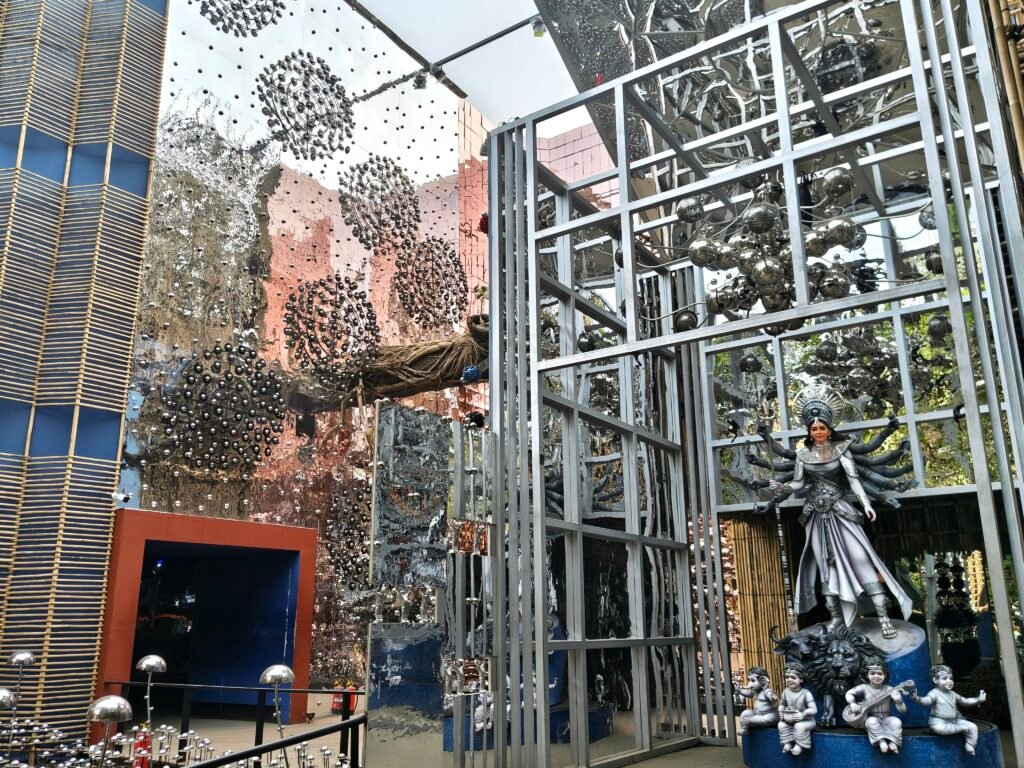
Arjunpur Amra Sabai Club began organising Durga Puja around 1973. It has developed a reputation for socially engaged themes that use the pandal to address questions of citizenship, rights, identity and human dignity.
In 2024, the theme “Anyo-Desh”, or Another Country, explored the Indian Constitution, fundamental rights, equality and justice. Its 2023 theme, “Ganadebata”, drew on events in Manipur and used the image of a tribal woman to represent resistance and resilience. These presentations show how the committee has used the festival as a platform for public reflection.
Address: NC-15, Arjunpur Road, Taltala, Kolkata 700080. Landmark: Near the Arjunpur Road and Jessore Road area, known for its annual Durga Puja
Nearest Metro: Dum Dum Metro Station (Blue Line), followed by an auto or bus connection
Nearest Bus Stop: Arjunpur or Baguiati Bus Stop along Jessore Road
63. Ahiritola Jubak Brinda | Est. 1975 | North Kolkata
Ahiritola Jubak Brinda is a separate community organisation from Ahiritola Sarbojanin Durgotsav, and it has organised its own Durga Puja since 1975. In 2025 the committee presented Rosnai, a concept built on the interplay of light and shadow. The organisers described illumination as more than decoration, using it to express unity, aesthetic sensibility, respect and collective happiness. The 2025 presentation placed lighting at the centre of the pandal’s artistic identity. The committee is also associated with cultural preservation and community service, including medical assistance, support for blood donation and other social work. These activities form part of the organisation’s identity beyond the annual festival.
Address: 83 and 86B, Ahiritola Street (opposite B.K. Paul Park), Kolkata 700005
Nearest Metro: Sovabazar Sutanuti Metro Station (Blue Line) or Girish Park Metro Station. Bidhannagar Road Railway Station is the nearest rail station.
Nearest Bus Stop: B.K. Paul / Sovabazar Bus Stop
64. Kestopur Prafulla Kanan | Est. 1977 | North-East Kolkata
Prafulla Kanan Balak Brinda Club (East) Sarbojanin Durgotsav has celebrated Durga Puja since 1977.
Address: Prafulla Kanan, Kestopur, North 24 Parganas, Kolkata 700101. Landmarks: Near the VIP Road and VIP More crossover, a State Bank of India ATM, and the well-known Prafulla Kanan Deshapriya Vidyamandir
Nearest Metro: Salt Lake Sector V Metro Station or Central Park Metro Station (Green Line), about 1.5 to 2.5 km away across the Kestopur Canal. Dum Dum Metro Station (Blue Line) is about 5.5 km away.
Nearest Bus Stop: Kestopur Bus Stop on VIP Road
65. Salt Lake BJ Block | Est. 1983 | Salt Lake
Established in 1983, the BJ Block Saradotsav Committee in Sector II marks its 43rd year with its signature dedication to experiential installations. The committee is renowned for past retrospectives that recreated vintage household objects and analogue history, such as “Phirey Dekha”. BJ Block treats its temporary pandal as an immersive historical museum. Operating from its block park grounds, it draws heavy evening crowds with carefully researched thematic narratives that evoke nostalgia and win wide appreciation among art lovers and history enthusiasts.
Address: BJ Block, Sector II, Salt Lake City, Bidhannagar, Kolkata 700091. Landmark: BJ Park, BJ Block Community Hall, BJ Market and 9 No. Island
Nearest Metro: Karunamoyee Metro Station (Green Line), about 1.1 to 1.3 km away. Central Park Metro Station (Green Line) is about 1.1 km away.
Nearest Bus Stop: 206 Bus Stand or Bus Stop, adjacent to the block. Tank No. 9 / 9 No. Island Bus Stop is also close by.
66. Salt Lake GD Block | Est. 1985 | Salt Lake
Established in 1985 by the GD Block Residents’ Association, this Sector III community puja is celebrating its 42nd year. The committee is known for socially and culturally conscious themes built around heritage symbols, gender empowerment and traditional rural life. GD Block is a dependable anchor on the Salt Lake festive trail. It is within easy reach of the Karunamoyee and Salt Lake Stadium metro stations, and the committee turns its block grounds into welcoming spaces that value both artistic merit and community engagement. Its ability to keep a traditional neighbourhood soul while delivering thoughtful, high-quality thematic displays has made it a favourite among visitors of all ages.
Address: GD Block, Sector III, Bidhannagar (Salt Lake City), Kolkata 700106. Landmark: GD Block Park and Bidhan Nagar IB Market
Nearest Metro: Central Park Metro Station (Green Line), about 2.0 km away. Karunamoyee Metro Station (Green Line) serves the Sector II and III boundary.
Nearest Bus Stop: GD Block Bus Terminus (also known as GD Block 47/1 Bus Terminus), within the block precinct
67. Naktala Udayan Sangha | Est. 1986 | South Kolkata
Naktala Udayan Sangha began its Durga Puja in 1986. The puja has become known for theme-led presentations that explore Bengali social life and cultural memory.
The 2026 theme is “Kalodhwani”, centred on the Bengali Panjika, or traditional almanac. The presentation explores the almanac’s evolution, from auspicious dates and ritual calendars to its typography, illustrations, advertisements and everyday social information. The concept recalls a familiar object that once had an important place in Bengali homes and festival preparations, but whose role has changed with digital calendars and modern communication. It is a strong example of cultural history recovered through an everyday object. Rather than relying on a famous monument, Naktala Udayan Sangha turns to the printed pages through which generations of Bengalis organised their religious and social life.
Address: 1/250, Naktala Road, Naktala, Garia, Kolkata 700047. Landmark: Near Naktala and Bansdroni
Nearest Metro: Gitanjali Metro Station (Blue Line), about 900 metres (a 10 to 12 minute walk to the north-west). Masterda Surya Sen Metro Station is another close option.
Nearest Bus Stop: Naktala Bus Stop
68. Dum Dum Park Tarun Sangha | Est. 1987 | North Kolkata
Dum Dum Park Tarun Sangha was established in 1987 and is known for concept-driven pandals that draw on literature, social relationships and cultural history. Its earlier presentations include Muktodhara in 2024, inspired by Rabindranath Tagore’s play and its themes of nature, freedom and human struggle, and Samparka in 2023, which explored the complexities of human relationships.
The 2026 theme is “Banijye Bosote Lakshmi”, a traditional Bengali expression that links commerce with prosperity. The presentation turns attention to trade, enterprise and the link between economic activity and cultural life. It is especially relevant to Bengal’s history of trade, in which river routes, markets and merchant communities shaped settlements and livelihoods. Both recent themes invite visitors to read the pandal as a narrative space rather than a backdrop for the idol.
Address: Tank No. 3, 530 Dum Dum Park Road, South Dum Dum, Kolkata 700055
Nearest Metro: Dum Dum Metro Station (Blue Line) or Central Park Metro Station (Green Line), followed by a short auto, toto or cab ride
Nearest Bus Stop: Dum Dum Park Bus Stop, along VIP Road and Jessore Road
69. Vaishnabghata Patuli Upanagari Sarbojanin | Est. 1988 | South-East Kolkata
Vaishnabghata Patuli Upanagari Sarbojanin Durgotsav serves the residents of the Vaishnabghata-Patuli township in South-East Kolkata. The puja is organised as a community celebration, bringing neighbours together for worship and festivity during the autumn festival.
Address: Block E, Baishnabghata Patuli Township, Patuli, Kolkata 700094. Landmark: Located at the Baishnabghata Patuli Upanagari Sarbojanin Durgapuja Ground, close to the Patuli Police Station and the famous Patuli Floating Market. It is also just a short walk (~0.19 km) from the Patuli Railway Station.
Nearest Metro Stations: Shahid Khudiram Metro Station: The absolute closest metro station, located approximately 0.41 km away. • Kavi Subhash (New Garia) Metro Station: Located roughly 0.54 km away, equating to about a 7-minute walk. Kavi Nazrul Metro Station: Located about 1.0 km away if walking on foot.
Nearest Bus Stop: Patuli Bus Stand / Patuli Bus Stop
70. Dakshindari Youth Association | Est. 2000 | North-East Kolkata
Dakshindari Youth Association, also listed as Dakshindari Youths Club, began organising Durga Puja around 2000. Its profile combines community participation with theme-based pandal design and social activity.
In 2025, its theme was “Dahan”, meaning burning, which used the imagery of struggle and destruction to explore courage, resilience and the triumph of good over cruelty. In 2024, the committee presented “Singhabahini”, a tribute connected with the centenary of Bengali filmmaker Tapan Sinha. The themes show a shift from cinematic and cultural remembrance to a more symbolic narrative of struggle.
Address: Dakshindari Road, South Dum Dum, Kolkata 700048. Landmark: Near the 17 No. Playground, close to Dakshindari Road and the 27 No. Rail Gate
Nearest Metro: Belgachia Metro Station (Blue Line), about 1.8 km away, roughly a 12 to 24 minute walk or a short auto or rickshaw ride. Bidhannagar Road Railway Station is the most convenient rail option, about 700 metres away (a 9 minute walk).
Nearest Bus Stop: Dakshindari Bus Stop, right in the vicinity. Ultadanga and Bidhannagar Road are also well connected by local buses.
71. Shakespeare Sarani Sarbojanin | Est. 2016 | Central Kolkata
Shakespeare Sarani Sarbojanin is organised by Kolkata Police personnel and was founded in 2016. In 2026 the committee introduced a named theme for the first time: The Creation of Mother Durga. The pandal depicts the mythological emergence of Mahishasuramardini through the combined energies of Brahma, Vishnu and Maheshwar. The puja’s identity is rooted in the relationship between police personnel and the surrounding community. The new theme also marks a move from a modest neighbourhood celebration towards a more deliberately designed presentation, while keeping its local public role.
Address: Shakespeare Sarani, Central Kolkata (near the Shakespeare Sarani Police Station and Kala Mandir stretch), Kolkata 700017
Nearest Metro: Maidan Metro Station (Blue Line), about 1.2 km (a 15 to 20 minute walk). Park Street and Rabindra Sadan metro stations are also nearby.
Nearest Bus Stop: Kalamandir / Shakespeare Sarani Bus Stop or Park Circus Maidan Bus Stop, with frequent local buses across central and south Kolkata
72. Sealdah Railway Athletic Club Sarbojanin | Central Kolkata
Sealdah Railway Athletic Club Sarbojanin Durgotsav is a community puja in the Sealdah area, where railway life and neighbourhood life overlap. The name points to an athletic club, a familiar model in Kolkata in which sport, social interaction and festival organising often belong to the same local network. The pandal stands close to Netaji Subhas Ground, in a part of the city that depends heavily on rail commuters and railway quarters.
Address: 78/E, Kaiser Street, Sealdah, Railway Quarter, near Netaji Subhas Ground, Raja Bazar, Kolkata 700014
Nearest Metro: Sealdah Metro Station (Green Line), a short walk or subway connection from Sealdah Railway Station. Central Metro Station is also reachable by a short transit or cab ride.
Nearest Bus Stop: Sealdah Station Bus Stop or Sealdah Court Bus Stop, near Vidyapati Setu and Kaiser Street
73. Taltala Sarbojanin Durgotsab | Central Kolkata
Taltala Sarbojanin Durgotsab belongs to Central Kolkata’s community puja tradition, in a neighbourhood with a long record of cultural and social activity. Its 2026 presentation is built around Vande Mataram, which commemorates the 150th anniversary of Bankim Chandra Chattopadhyay’s celebrated national song. The theme links the annual festival with India’s literary and nationalist heritage and brings a piece of Bengali literature into a contemporary public celebration. It fits a year in which several Kolkata pujas have drawn on historical memory and national identity. Santosh Mitra Square has also taken a related theme, though the two committees’ presentations should not be assumed to be the same.
Address: Taltala, Central Kolkata, Kolkata 700014. Landmark: Near S.N. Banerjee Road
Nearest Metro: Esplanade Metro Station (Blue and Green Lines), about 552 metres (a 7 minute walk). Park Street Metro Station (Blue Line), about 662 metres (a 9 minute walk).
Nearest Bus Stop: Taltala Bus Stop on S.N. Banerjee Road. Esplanade Bus Terminus is a major hub within walking distance.
74. Ahiritola Sarbojanin Durgotsav | North Kolkata
Ahiritola Sarbojanin Durgotsav is one of North Kolkata’s historic community pujas, located near Ahiritola Ghat in an old neighbourhood tied to the city’s riverfront life. The committee’s history goes back to the early twentieth century.
For 2026 the theme is “Madhuri Maitrir Anweshane”, meaning In Search of Sweetness and Togetherness. The concept looks at North Kolkata’s sweets culture and the role of neighbourhood sweet shops in everyday social life. By linking Bengali mishti with friendship, memory and community ties, the presentation treats food as part of the social history of the para, not only as a culinary tradition. It offers a contrast to the monumental reproductions of some newer pujas, drawing on details of ordinary life to recall the older social world of the area.
Address: 55, B.K. Pal Avenue, Ahiritola, Kolkata 700006
Nearest Metro: Sovabazar Sutanuti Metro Station (Blue Line), about an 8 to 10 minute walk. Shyambazar Metro Station (Gate 4) is also nearby.
Nearest Bus Stop: B.K. Pal / Sovabazar Bus Stop, or stops along Rabindra Sarani and A.P.C. Road near Ahiritola Ghat
75. Beniatola Sarbojanin Durgotsav | North Kolkata
Beniatola Sarbojanin Durgotsav belongs to the traditional community-puja landscape of North Kolkata, an area where closely settled neighbourhoods have long kept collective worship alive. The puja sits in the historic Beniatola locality, part of the wider cultural landscape of old North Kolkata. It lies close to neighbourhoods known for traditional artisans, markets and community celebrations. The festival here is shaped by the same dense streets and shared social life that define the area.
Address: 67, Beniatola Street, Sovabazar, near B.K. Paul Avenue crossing, Kolkata 700005. Landmark: Near the B.K. Paul Avenue crossing and the Sovabazar area
Nearest Metro: Shobhabazar Sutanuti Metro Station (Blue Line), about 700 to 850 metres (6 to 10 minute walk). Girish Park Metro Station is within a 15 minute walk.
Nearest Bus Stop: Rabindra Sarani, Kumartuli and Sovabazar bus stops on the main thoroughfares, including Rabindra Sarani and B.K. Paul Avenue, served by local city buses
76. Kankurgachi Jubak Brinda | East Kolkata
Kankurgachi Jubak Brinda is a community puja with a documented history of experimenting with artistic pandal design. Its 2013 presentation was styled as a weapon arsenal, with the pandal shaped like an old helmet. In 2014, the committee presented “Rather Mela”, or a chariot fair, with distinctive lighting and an elegant Durga idol. Artist Anirban Das was credited with both concepts. These records show the committee’s interest in turning familiar objects and cultural settings into festival installations.
Address: 70A, Kankurgachi 2nd Lane, Kankurgachi, Kolkata 700054. Landmark: Near the Kankurgachi Rail Bridge, close to Phoolbagan and Maniktala Main Road
Nearest Metro: Phoolbagan Metro Station (Green Line), about 840 metres (a 5 to 10 minute walk)
Nearest Bus Stop: Kankurgachi More Bus Stop or Maniktala Main Road Stoppage
77. Ultadanga Karbagan Sarbojanin | East Kolkata
Ultadanga Karbagan Sarbojanin belongs to the community-puja tradition of East Kolkata. The wider Ultadanga area has a strong network of neighbourhood associations, each with its own festival history and artistic identity.
Address: 17 Ultadanga Main Road, Daspara, Ultadanga, Kolkata 700067. Landmark: Near Muchibazar and Pallyshree Club / Karbagan
Nearest Metro: Shyambazar Metro Station (Blue Line) or Belgachia Metro Station (Blue Line), about 1.5 to 1.9 km away, with a short auto or cab ride to the site
Nearest Bus Stop: Muchibazar / Ultadanga Main Road Bus Stop
78. Mitali Sangha | East Kolkata
Mitali Sangha is a community puja in Kankurgachi. For 2026 the theme is “Uttam Kumar Akai 100”, marking the centenary of the celebrated Bengali film star. The concept brings the history of Bengali cinema into the Durga Puja pandal, inviting visitors to revisit an actor whose screen presence became part of Bengal’s cultural memory. Uttam Kumar’s centenary has inspired several tributes in 2026, which makes cinema and popular memory important themes of this year’s festival.
Address: 214J, Manicktala Main Road, Kadapara, Kankurgachi, Kolkata 700054. Landmark: On the main road, near the Kankurgachi Post Office and Kankurgachi Crossing
Nearest Metro: Bengal Chemical Metro Station (Green Line) is the closest option. Phoolbagan Metro Station (Green Line) is also nearby, reachable by auto or a short vehicle ride.
Nearest Bus Stop: Kankurgachi Crossing / Kankurgachi Post Office Bus Stop
79. Samaj Sebi Sangha | South Kolkata
Samaj Sebi Sangha is a prominent South Kolkata community puja with a history of socially engaged presentations. Its 2025 theme drew on Satyajit Ray’s Pather Panchali and the violence and hardship associated with the 1946 Kolkata riots. The installation recalled the committee’s history of providing food, shelter and assistance to people in distress, linking the festival with the memory of community service.
In 2026, the theme is “Mahapujoy Mahanayak”, a tribute to Uttam Kumar on the centenary of his birth. The presentation recreates elements of the 1950s and 1960s, using sepia tones, film posters and period lettering to evoke the actor’s era.
Address: 24A, Lake View Road, Sarat Bose Road, Ballygunge, Kolkata 700029. Landmark: Near Triangular Park (Sarat Bose Road crossover) and Lake View Road
Nearest Metro: Rabindra Sarobar Metro Station (Blue Line), followed by a short auto or taxi ride
Nearest Bus Stop: Triangular Park Bus Stop or Deshapriya Park Bus Stop, both a short walk from the club entrance
80. Bosepukur Talbagan | South Kolkata
Bosepukur Talbagan is a separate community puja from Bosepukur Sitala Mandir, although both are in the same wider neighbourhood. Its themes show an interest in literature, Bengali cultural traditions and social questions. In 2024, “Raktakarabi”, inspired by Rabindranath Tagore’s play Red Oleanders, explored freedom, oppression and resistance through symbolic art. In 2025, the theme was “Paritraan”, meaning salvation or deliverance.
Address: 1/27, Bose Pukur Road, Tal Bagan, Bosepukur, Kasba, Kolkata 700042. Landmark: Kasba Police Station on Bose Pukur Road, near Kasba Bosepukur Sitala Mandir and the Regenta Orkos hotel
Nearest Metro: Hemanta Mukhopadhyay Metro Station (Orange Line), about 1.7 km away. A short auto or cab ride down the Rashbehari Avenue Connector takes you to the neighbourhood.
Nearest Bus Stop: Tal Bagan Bus Stop, about 300 metres away. K.M.C. Pumping Station Bus Stop is also about 300 metres away on Bosepukur Road.
81. Jodhpur Park Sarbojanin | South Kolkata
Jodhpur Park Sarbojanin is a distinct neighbourhood puja, separate from the nearby 95 Pally. It belongs to the Jodhpur Park, Selimpur and Dhakuria circuit, where several community celebrations can be visited in one outing.
Address: Jodhpur Park Durga Puja Ground, Jodhpur Park, Kolkata 700068. Landmark: Near Jodhpur Park Boys School and Sri Aurobindo Seva Kendra (EEDF Hospital)
Nearest Metro: Rabindra Sarobar Metro Station, about 417 metres (a 6 minute walk or a short auto ride). Jatin Das Park Metro Station, about 743 metres (a 10 minute walk). Kalighat Metro Station, about 838 metres (an 11 minute walk).
Nearest Bus Stop: Major routes run along Rashbehari Avenue, Gariahat Road and Prince Anwar Shah Road, including routes between Esplanade and Garia, Rashbehari and Ballygunge, and Hazra and Golpark. Jodhpur Park, South City and Dhakuria bus stops are a short walk from the park ground.
82. 95 Pally, Jodhpur Park | South Kolkata
95 Pally is another separate puja in the Jodhpur Park area. Its 2026 theme is “Guptayan”, a concept built around concealment, hidden meanings and a journey into what is not immediately visible. The creative presentation is associated with artist Parimal Pal.
Address: 70A, Rahim Ostagar Road, Jodhpur Park, Kolkata 700068. Landmark: Near Jodhpur Park Market
Nearest Metro: Mahanayak Uttam Kumar Metro Station
Nearest Bus Stop: Rabindra Sarovar Bus Stop
83. Rajdanga Naba Uday Sangha | East/South Kolkata
Rajdanga Naba Uday Sangha is known for ambitious theme-based presentations and year-round social activity. Its 2025 theme was “Proshno”, meaning Question, which approached the universe as a vast field of questions. For 2026, the theme is “Shodhon”, meaning Purification, with artist Debasis Barui associated with the concept.
Address: A-33, Rajdanga Nabapally Main Road, Rajdanga Chakraborty Para, East Kolkata Township, Kolkata 700107. Landmark: Acropolis Mall
Nearest Metro: Hemanta Mukhopadhyay Metro Station (Orange Line), about 1.8 km on foot. VIP Bazar or Kasba-side stations are about 1.1 km away on foot, depending on the route.
Nearest Bus Stop: Rajdanga Bus Stop on Rajdanga Main Road
84. Ajeya Sanghati | South Kolkata
Ajeya Sanghati in South Kolkata is celebrated for its creative, concept-driven Durga Puja presentations that push the boundaries of modern pandal design. Located in the lively residential heart of Haridevpur, the committee has carved out a distinct identity by turning its pandal into an immersive canvas that addresses social narratives, ecological concerns and folk aesthetics through careful craftsmanship. Rather than relying solely on grand opulence, Ajeya Sanghati focuses on artistic depth, atmospheric lighting and eco-friendly installations that engage visitors both intellectually and visually. It is easy to reach during the festive rush and forms a useful stop on any South Kolkata puja itinerary, drawing art enthusiasts and culture seekers who look for innovation rooted in community values.
Address: 47, Mahatma Gandhi Road, Haridevpur, Kolkata 700082. Landmark: Near the Haridevpur Post Office and Jiban Mohini Ghosh Park
Nearest Metro: Netaji Metro Station (Blue Line), about 1.1 km away. A walk of about 15 minutes or a short auto or cycle-rickshaw ride westward along Mahatma Gandhi Road. Mahanayak Uttam Kumar Metro Station is another nearby option.
Nearest Bus Stop: Haridevpur Bus Stop, on Mahatma Gandhi Road
85. Babubagan Sarbojanin | Dhakuria
Babubagan Sarbojanin Durgotsav in Dhakuria is one of South Kolkata’s most prestigious and eagerly anticipated community pujas, known for its scale and traditional elegance. The puja has built a reputation for combining classical architectural splendour with contemporary artistic themes, often featuring majestic idols and large pandals that draw wide admiration. Situated near the Dhakuria-Golpark connector, it sits on a busy route that brings crowds of pujo hoppers every evening. Beyond the visual spectacle, Babubagan keeps a close neighbourhood spirit, with traditional rituals, community participation and the warm welcome that defines Kolkata’s autumn celebrations.
Address: 14, Babu Bagan Lane, Tarkeshwar Sen Uddyan, Dhakuria, Kolkata 700031. Landmark: Tarakeshwar Sen Uddyan (also known as Tarkeshwar Sen Park)
Nearest Metro: Rabindra Sarobar Metro Station (Blue Line), the closest operational metro station, followed by a short auto or cab ride. Kalighat Metro Station (Blue Line) is also nearby.
Nearest Bus Stop: Dhakuria Bus Stand or Babu Bagan Bus Stop, on Dhakuria Station Road and Gariahat Road South, a short walk from the pandal
86. Barisha Players Corner | Behala
Barisha Players Corner in Behala is a major name in South Kolkata’s competitive pujo landscape. Known for its avant-garde themes and structural installations, the committee consistently builds immersive visual narratives that take visitors into otherworldly environments, drawing on local artisans’ skills to create memorable spaces. Located in the busy hub of Behala, it has become a key stop for pandal hoppers on the south-western circuit. The committee balances artistic experimentation with strong production values, which makes it a good destination for anyone looking for bold creativity and engaging storytelling during Durgotsav.
Address: Raja Rammohan Roy Road, Behala Chowrasta, Barisha, Kolkata 700008. Landmark: Near the Behala Chowrasta Crossing
Nearest Metro: Behala Chowrasta Metro Station (Purple Line), about 200 metres (a 2 minute walk)
Nearest Bus Stop: Behala Chowrasta Bus Stop, at the main crossing, reachable by any bus along Diamond Harbour Road
87. Aurobinda Setu Sarbojanin | North-East Kolkata
Aurobinda Setu Sarbojanin is a cultural gateway that links North Kolkata with the Eastern Metropolitan Bypass, near the Ultadanga Bridge approach. The committee has built a strong following among the commuters who pour into the northern festive circuit every autumn, and it begins preparations early each year with traditional Khuti Pujo ceremonies. Working with artisan Gouranga Das, the organisers focus on large structural designs that combine engineering with thematic appeal. Anchored at one of the city’s busiest transit intersections, the puja offers an energetic and accessible celebration that sets the tone for visitors entering the northern pandal trail.
Address: 9/1/5, Canal East Road, Daspara, Ultadanga, Kolkata 700067. Landmark: Near the Aurobindo Setu Bridge, on the Daspara and Ultadanga side
Nearest Metro: Phoolbagan Metro Station (Green Line) is the most popular connection for this pandal belt. Shared autos towards Ultadanga are easy to find from the station.
Nearest Bus Stop: Aurobindo Setu Bus Stop or Daspara Bus Stop, at the foot of the bridge and within a short walk of the pandal. Ultadanga Bus Stand / Hudco More is a 5 to 10 minute walk or a short rickshaw ride away.
88. Lake Town Netaji Sporting Club | Lake Town
Netaji Sporting Club is entering its 47th year in 2026. The club’s 2026 banner carries the line “Notun Juger Prothom Pujo”, or The First Puja of a New Era, which signals a fresh beginning.
Address: Block-A, Lake Town, Kolkata 700089. Landmark: Near Lake Town Swimming Pool and beside Jaya Cinema Hall
Nearest Metro: Dum Dum Metro Station (Blue Line), followed by a short auto, cab or rickshaw ride. City Centre Metro Station (Green Line) is also nearby in Bidhannagar.
Nearest Bus Stop: Local routes along Lake Town and VIP Road
89. Pradeep Sangha Natunpally | Salt Lake
Natunpally Pradeep Sangha is a celebrated name in Lake Town’s puja landscape, with a decorated history that includes consecutive wins in major city-wide competitions such as the Asian Paints Sharad Samman. Marking its 46th year, the committee unveiled an ambitious presentation titled “Kurukshetra”, envisioned and crafted by artists Arindam and Tanushree. The pandal turns the motifs of ancient epic warfare into an immersive structure, combining dramatic lighting with intricate detailing that engages visitors on both visual and emotional levels. Known for its commitment to artistic excellence, the club continues to draw crowds who look for bold, narrative-driven themes in the north-eastern sector.
Address: 85, S.K. Deb Road (Amalangshu Sen Road), Patipukur, Natunpally, Kolkata 700048. Landmark: Near the Sree Bhumi area and the Patipukur Fish Market
Nearest Metro: Belgachia Metro Station (Blue Line)
Nearest Bus Stop: East Central Bus Stop or Patipukur Bus Stop, about 150 metres away on S.K. Deb Road. Lake Town VIP Road Crossing is a major alternative junction if you are coming via VIP Road.
90. Salt Lake FD Block | Salt Lake
Salt Lake FD Block is known not only for its pandal but also for its residents’ cultural programme, which brings neighbours together through music, dance, theatre and other performances. During the pandemic the block moved its programme online, including performances by children and by residents living abroad, and used Dokra-inspired figures and Bankura horses in a traditional-art presentation.
The block is celebrating its 42nd year in 2026 with “Nakshi Kanar Math”, a theme centred on Gond art, an indigenous visual tradition associated with central India. The installation uses lines, dots and colourful figures, including birds and animals, to build a visual narrative from an art form that is less familiar to many puja visitors.
Address: FD Block Park, Sector III, Salt Lake City, Bidhannagar, Kolkata 700106. Landmark: Near FD Block Park and Pour Bhawan, the Bidhannagar Municipal Corporation office area
Nearest Metro: Karunamoyee Metro Station, about 900 metres (an 11 minute walk). Central Park Metro Station is about 1.1 km away. City Centre Metro Station is about 1 km on foot.
Nearest Bus Stop: Karunamoyee Bus Terminal or Karunamoyee Central Bus Stop, or local stops around Sector III and Pour Bhawan, connecting major parts of Kolkata, Ultadanga and Sealdah
91. Salt Lake EC Block | Salt Lake
Salt Lake EC Block Residents Association celebrates its 50th year in 2026. Its golden-jubilee theme is “Akkhayani”, drawing on the Mahabharata and its epic narratives.
Address: EC Block, Sector I, Bidhannagar, Kolkata 700064. Landmark: EC Market and EC Block Park, near City Centre 1. Nearest Railway Station: Bidhan Nagar Road Railway Station
Nearest Metro: City Centre Metro Station (Green Line), about 400 metres (a 5 to 6 minute walk)
Nearest Bus Stop: City Centre 1 Bus Stop or EC Market Bus Stop, served by regular local and sector buses
92. Salt Lake AK Block | Salt Lake
Salt Lake AK Block’s 2026 concept draws on Bharatchandra Ray’s Annadamangal and its enduring prayer, “Amar santan jeno thake dudhe-bhate”, or May my children have enough to eat. The presentation places hunger and the wish for food security at the centre of the story, using a literary work to connect an old prayer with a continuing human need.
Address: AK-199, AK Block, Sector II, Bidhannagar, Kolkata 700091. Landmark: Near Karunamoyee, Karunamoyee Bus Terminal and the Central Park area of Salt Lake Sector II
Nearest Metro: Karunamoyee Metro Station (Green Line), about 1.0 to 1.2 km away. Salt Lake Sector V Metro Station is about 1.2 km on foot.
Nearest Bus Stop: Karunamoyee Bus Terminal, a short auto ride or walk from the block
93. Salt Lake AE Block | Salt Lake
Salt Lake AE Block is one of the pioneering residential block pujas in Sector I. It has built a legacy of several decades, drawing crowds from across the city with carefully planned open-concept block designs and warm community hospitality. Set within the green expanse of the block park near the City Centre transit corridor, the puja balances grand visual spectacle with neighbourhood intimacy. Over the years, the committee has often worked with creative directors such as Partha and Siddhartha Ghosh to curate thematic installations. AE Block remains a family-friendly destination for pandal hoppers looking for classic Salt Lake community warmth combined with considered artistic direction.
Address: AE Block, Sector I, Salt Lake City, Bidhannagar, Kolkata 700064. Landmark: Near AE Block Park and AE Market, close to AD Block, BD Block and CE Block
Nearest Metro: City Centre Metro Station (Green Line), about 1.3 to 1.7 km (15 to 20 minutes on foot). Central Park Metro Station (Green Line) is about 1.5 km away.
Nearest Bus Stop: CA Market Bus Stop
94. Telipukur Yuba Sangha | Lake Town
Telipukur Yuba Sangha has earned wide critical praise for stepping away from commercial extravagance in favour of socio-environmental themes that resonate emotionally. For its presentation, the committee has introduced the theme “Ek Pukur Bhalobasha” under the creative direction of artist Bhabatosh Sutar. The installation explores the vanishing village ponds of Bengal, not merely as bodies of water but as historic centres of community life, adda and shared neighbourhood ties. Located near the Lake Town fringe, the pujo offers a reflective and atmospheric experience that highlights the need to preserve ecological and cultural heritage.
Address: Ananda Mohan Bose Road, Telipukur, Amarpalli, Dum Dum, Kolkata 700074. Landmark: Near Nursery Bagan and Dum Dum Nagerbazar
Nearest Metro: Dum Dum Metro Station, the most convenient option. Commuters can take an auto or a direct bus towards Nagerbazar or Satgachi from there.
Nearest Bus Stop: Satgachi Bus Stop or Nagerbazar Bus Stop
95. Baguiati Railway Pukur United Club | Baguiati
Baguiati Railway Pukur United Club is a major cultural name in the busy Baguiati area, celebrating its 73rd year of Durgotsav. The club drew wide attention in the print media for its eco-friendly theme, “Collage”. The entire structure is built from recycled newspapers collected from local households, woven together into an artistic tribute to the cultural icons of Bengal. The approach shows both craft mastery and a strong commitment to environmental sustainability, making it a notable stop on the VIP Road puja circuit.
Address: DA/3, Rail Pukur Road, Shastri Bagan, Desh Bandhu Nagar, Baguiati, Kolkata 700059. Landmark: Near Railpukur Main Road and within walking distance of Joramandir
Nearest Metro: Dum Dum Metro Station (Blue Line), connected by regular buses and autos. Salt Lake Sector V / Phoolbagan Metro Station (Green Line) can be reached by auto or bus via the EM Bypass or the Salt Lake bypass.
Nearest Bus Stop: Baguiati Bus Stand or Joramandir Bus Stop, a short walk along VIP Road
96. New Town Sanatani Durga Puja | New Town
New Town Sanatani Durga Puja has become one of the most talked-about community celebrations in the township’s growing cultural calendar, drawing public and media attention. Its presentations have often combined patriotic and scientific themes, including installations inspired by national milestones such as Chandrayaan and Aditya-L1, alongside traditional ceremonial grandeur. Set against the modern backdrop of New Town, the celebration brings together futuristic civic aspirations and classical devotion, drawing large crowds of residents and visitors from across the city.
Address: New Town Mela Ground, Major Arterial Road (MAR), Action Area I, New Town, Kolkata 700156. Landmark: Right near the Biswa Bangla Gate (Kolkata Gate) crossing
Nearest Metro: Salt Lake Sector V Metro Station (Green Line), the most functional nearest station. From there, an auto, e-rickshaw or transit bus will take you to the Biswa Bangla Gate crossing. The New Town Line (Orange Line) stations along the Major Arterial Road, such as Biswa Bangla Convention Centre and Eco Park, will be closer once they are fully operational.
Nearest Bus Stop: New Town Bus Stand or Biswa Bangla Gate Stop
97. New Town Sarbojanin Durga Puja | New Town
New Town Sarbojanin is a foundational community puja in the residential and commercial sectors of New Town. The committee’s annual celebrations are known for their expansive structures and carefully crafted traditional idols, designed for the township’s diverse population. By combining open spatial planning with traditional rituals, New Town Sarbojanin offers a comfortable, grand-scale festive hub for local families and visitors looking for a classic Durga Puja in the eastern planned township.
Address: New Town Durga Puja Committee, BG Block, Action Area 1B, New Town, Kolkata 700163. Landmarks: City Square Ground, Newtown Clock Tower, Axis Mall and the Pride Hotel junction
Nearest Metro: Salt Lake Sector V Metro Station (Green Line), followed by a short auto, cab or rideshare ride
Nearest Bus Stop: New Town Bus Stand or Axis Mall Bus Stop, about a 5 minute walk from the ground
98. Sadanga Durgotsav Samity | North Kolkata
Sadanga Durgotsav Samity is located in North Kolkata, diagonally opposite Jagat Mukherjee Park, and has earned wide praise for its striking, narrative-driven art installations. For its festive presentation, the committee selected the literary and satirical theme “Hutom Pyanchar Naksha”, inspired by Kaliprasanna Sinha’s 19th-century social sketches of Kolkata. Created with artist Avindra, the pandal combines historical social critique with fine visual craftsmanship, offering a thoughtful and visually striking experience for visitors on the northern puja trail.
Address: 51, Raja Raj Ballav Street, Bag Bazar Colony, Sovabazar, Bidhan Sarani, Baghbazar, Kolkata 700003. Landmark: Located in Shyambazar Rajballav Para, directly opposite Jagat Mukherjee Park
Nearest Metro: Shyambazar Metro Station (Blue Line), the most popular choice for commuters, or Shobhabazar Sutanuti Metro Station (Blue Line)
Nearest Bus Stop: Rajballav Para Bus Stop, within walking distance of the pandal
99. Salt Lake Laboni Estate Puja | Salt Lake
Laboni Estate Puja is one of Salt Lake’s oldest housing estate community celebrations, marking its 52nd year. Blending residential warmth with classical structural design, the estate puja remains a cornerstone of the Sector I housing circuit. Its location offers easy access for those arriving on foot from Salt Lake Stadium metro station, and the atmosphere stays focused on community participation and traditional rituals, without the commercial clutter found elsewhere.
Address: Labony Estate, Salt Lake Sector I, Bidhannagar, Kolkata 700064. Landmark: Near Susrut Eye Hospital and City Centre Salt Lake
Nearest Metro: City Centre Metro Station (Green Line), about 600 metres on foot. Central Park Metro Station is about 1.21 km away.
Nearest Bus Stop: Susrut Eye Hospital Bus Stand, about 1.44 km away, or the Salt Lake 206 Bus Terminus
100. Allen Park | Est. 2026 | Park Street
Allen Park on Park Street is the historic heart of Kolkata’s winter celebrations, and this year it hosts its first-ever Durga Puja, organised by the Kolkata Sanatani Sangha. The park is traditionally known for its Christmas lights and carols. This year it opens its cultural canvas to Bengali festive heritage. Led by committee members Shankudeb Panda and Navin Mishra, the debut celebration features regional folk traditions such as Baul music, along with a Varanasi-style evening aarti from Chaturthi to Dashami. With traditional Sanatani rituals and detailed crowd management by Kolkata Police, Allen Park is set to become a new festive landmark during Durgotsav.
Address: Allen Park, Park Lane, 63 Park Street (Mother Teresa Sarani), Kolkata 700016. Landmark: Located at the intersection/crossing of Park Street (Mother Teresa Sarani) and Camac Street / Wood Street
Nearest Metro: Park Street Metro Station (Blue Line & Purple Line interchange): Located approx. an 8 to 10-minute walk away (via Chowringhee Road / Park Street).
Nearest Bus Stop: Park Street Crossing / Camac Street Bus Stop
The establishment years mentioned in this article are based on the information available to us at the time of writing. They may differ from the actual founding years of some pandals. Whenever a confirmed year is found, we will update it in the article.