12 October 2026
People Pen Desk
Newspaper notices from 1814 to 1840 and this year’s state announcements show how the festival’s hosts, costs and paperwork have changed.
At Eden Gardens on 10 October, Chief Minister Suvendu Adhikari said about 45,000 Durga Pujas were held in West Bengal last year. He said 12,400 new committees had been permitted this year. The record of who hosts and funds the festival goes back much further.
Houses built for five days
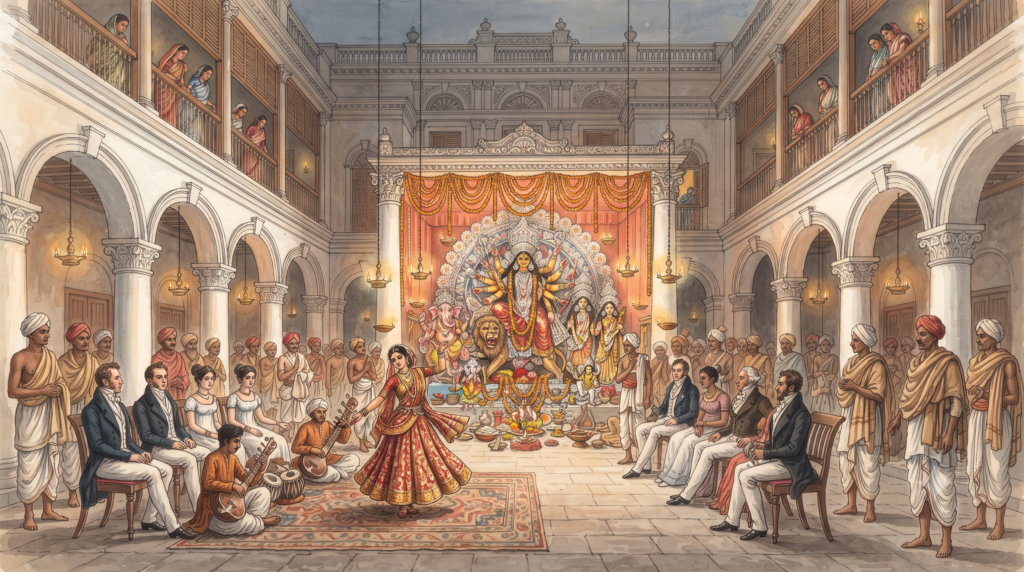
By the late 18th century, specialist artisans had settled in Kumartuli, north Calcutta, and made images in different sizes for wealthy patrons. The image was installed in the thakurdalan, which faced an open courtyard with columned verandas and had halls for performances next to it. Men received guests in the courtyard, while the women of the house took part in rituals and often watched the evening programme from screened rooms.
Sovabazar Rajbari has a separate nachghar, built to entertain European guests. Another household, on Beadon Street, began its puja in 1770 under Ram Dulal Dey. The Dattas of Hathkhola and the Mitras of Dorjeepara were also among the families that built mansions and held elaborate pujas.
Older accounts
Accounts from before 1800 describe a different arrangement. A clerk named James Mitchell wrote in 1748 that Europeans who were admitted sat at their own tables, and that cannon were fired during the immersion procession. L. de Grandpré, a French officer, wrote of his visit in 1789-90 that every quarter of the town had at least one celebration, and that those who could not host went to a neighbour’s. Neighbourhood access was thus recorded well before the community pujas of the 20th century.
What the newspapers announced
The Calcutta Gazette of 20 October 1814 told readers where the singer Nikhee would perform, which mansion had the singer Ushoorun, and which household had brought jugglers from Lucknow. A report in 1826 described Burmese dancers at Gopee Mohun Deb’s house, with ladies and gentlemen among the guests. In 1827, Pran Kissen Holdar of Chinsurah advertised a nautch open even to strangers, with tiffin, dinner and wines. William Prinsep, a merchant with the Calcutta firm Palmer & Company, painted a house scene of Europeans being entertained during the puja.
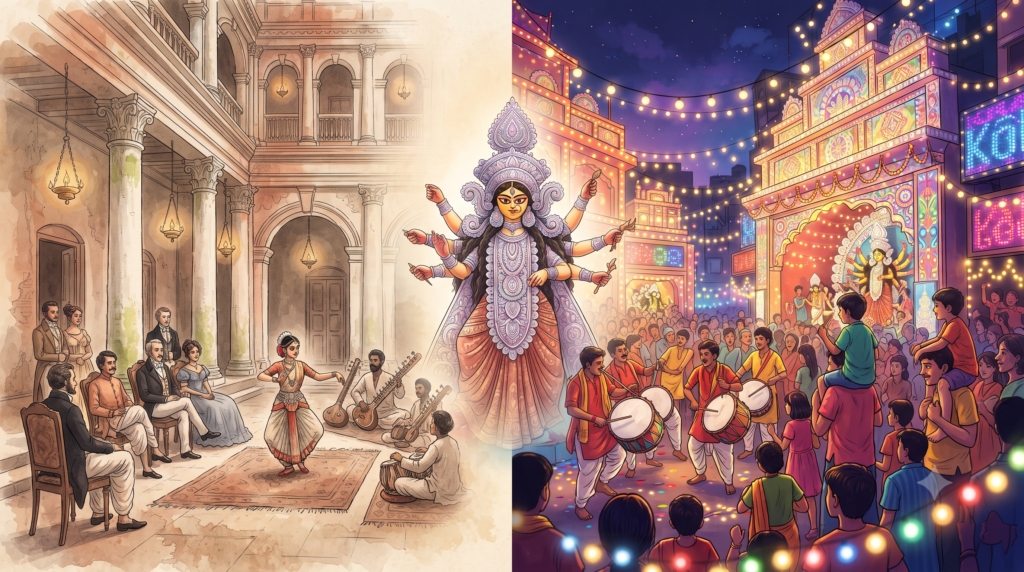
This hospitality is said to have had a business side. Entertaining an administrator, judge, officer or merchant could open the way to jobs, contracts or introductions. Hosts served European food and French wines, and offered imported furnishings, Western bands, pantomimes and ventriloquists. European writers on the nautch showed fascination, condescension and moral unease by turns.
The cost in 1839
The Friend of India reported that about 7,000 idols of the goddess were made in Calcutta in 1839, at a cost of some Rs 25 lakh. By simple division, that is roughly Rs 357 an idol.
Worship and charity alongside the spectacle
Brahmins were fed and alms were distributed, and some patrons reportedly paid prisoners’ debts. Some families, such as the Basumullicks of Pataldanga and the Dattas, were known for restraint and kept public entertainment limited in their courtyards.
When the Sahibs Stopped Coming
The guest list began to change by the 1830s. A 2024 paper in the Journal of Festive Studies says a Calcutta Gazette editorial of 1829 noted that Bengali hosts had reduced their entertainment during the puja. Young officers and ship captains still went to nautches, but senior officials stayed away, fearing criticism in Britain. The same editorial said a European might watch a nautch once out of curiosity, but found it dull and repetitive.
Missionaries called nautch performances morally corrupt, and in the 1840s Bishop Daniel Wilson of Calcutta publicly criticised the puja as backward and in poor taste. Performers’ fees reportedly fell sharply, and heavy spending strained some families. The festival still shaped the European calendar, though. J.H. Stocqueler wrote that many Europeans left Calcutta during the holidays, and that shops and offices stayed shut for eight to ten days.
After the mansions: the festival moves outdoors
By tradition, the community model began at Guptipara in Hooghly, when men stopped from joining a household puja organised their own. The practice then spread to Chinsurah, Santipur and Kancharapara, and finally to Kolkata. By 1840, the Calcutta Courier was reporting complaints about forced collections for a barowari puja in Behala. UNESCO inscribed Durga Puja in Kolkata on its intangible heritage list in December 2021.
State funding has followed. In 2018 the government announced Rs 10,000 each for 28,000 committees, costing about Rs 28 crore. The Calcutta High Court stayed the order on an interim basis. By 2024 the grant was Rs 85,000, and 670 of 2,757 registered committees in and around Kolkata had applied. This year it is Rs 1 lakh, and more than 200 committees declined it, asking that the money go to rural and women-run pujas. Mr Adhikari also said that earlier, organisers had to approach the Calcutta High Court for permission.