
10 October 2026
People Pen Desk
Before the first dhak beats fill the streets and the pandals open their doors, Bengal wakes to a morning of prayers, memories and one unmistakable radio voice. It is the signal that the season of Durga has arrived.
In many Bengali homes, the day starts before sunrise, with the family gathered quietly around the radio and thoughts turning to relatives who are no longer alive. This is Mahalaya. For many Bengalis it is not just a date on the calendar. It is the point at which the festival starts to feel real, even though the main days of Durga Puja are still some way off.
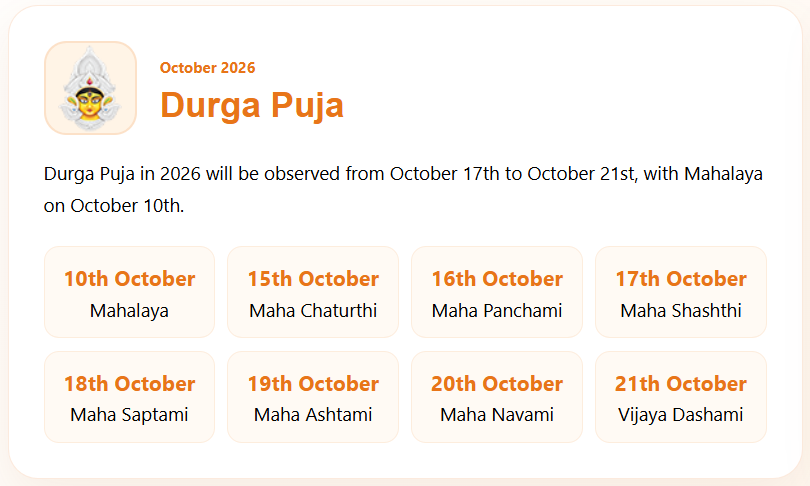
On Saturday, 10 October 2026, Mahalaya falls at the close of Pitru Paksha, the period set aside for honouring departed ancestors, and opens Devi Paksha, the fortnight associated with the Goddess. The day asks people to remember where they came from while they prepare to welcome what comes next.
A morning that begins with remembrance
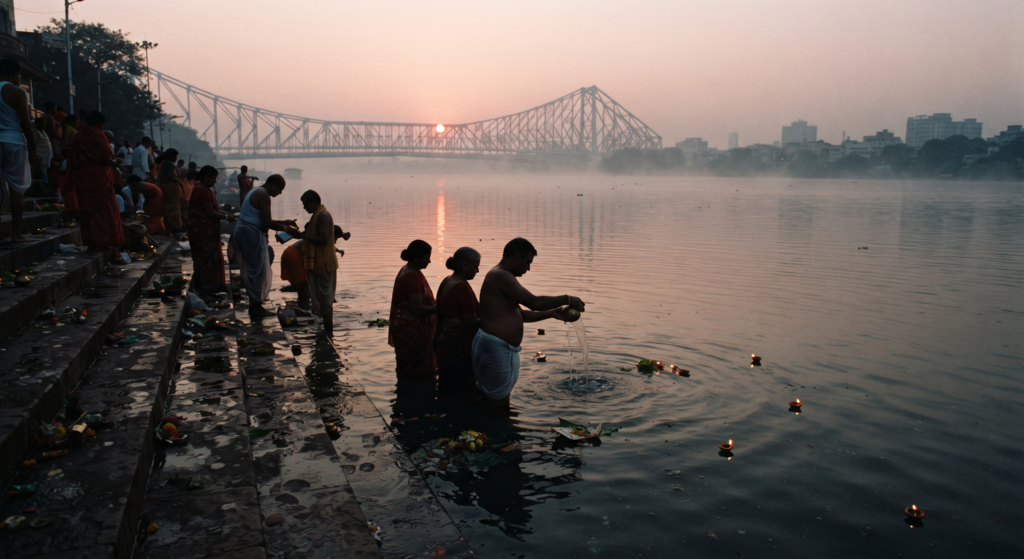
Before the city is fully awake, people gather at riverbanks and ghats to perform tarpan, a ritual offering of water in memory of the dead. In Kolkata, the banks of the Hooghly are an important place for these observances, as families remember their forebears and offer prayers for them.
Pitru Paksha, literally the fortnight of the ancestors, falls in a part of the Hindu lunar calendar when families perform shraddha and other rites for those who have died. Depending on family and regional custom, these may include offerings of water, sesame seeds and food, along with prayers.
Mahalaya Amavasya, also known as Sarva Pitru Amavasya, matters most to families who want to honour ancestors whose death anniversary is unknown, or whose rites could not be performed on an earlier day of Pitru Paksha. The ritual rests on a simple idea: the bond between the living and the dead continues through memory, gratitude and customs handed down within families.
From Pitru Paksha to Devi Paksha
The move from Pitru Paksha to Devi Paksha gives Mahalaya its distinct place in Bengal’s religious calendar. The first fortnight is about remembrance and offerings to ancestors. The second turns towards the worship of the Divine Mother and Durga Puja.
In Bengali tradition, Goddess Durga is welcomed as Uma, a daughter coming home from Kailash to visit her parents and her children on earth. This gives the festival a personal side. The Goddess is the powerful slayer of Mahishasura, and she is also a beloved daughter whose return brings joy to her family.
Agamani songs tell this part of the story through the eyes of her mother, Menaka, who waits for her daughter to arrive. Because the songs draw on the love and longing of a daughter returning home, they feel familiar to Bengali households. Mahalaya therefore holds two feelings at once: the solemnity of remembering the dead and the happiness of preparing to receive the Goddess.
Invoking the Goddess and the triumph over Mahishasura
Mahalaya is also linked to the invocation of Durga and her battle with Mahishasura, the demon who threatened the gods. In the Devi Mahatmya, also known as the Chandi, the Goddess is born from the combined power of the gods and defeats Mahishasura once he becomes a danger to the cosmic order.
The image of Durga facing the demon, armed and riding a lion, has become one of the defining visuals of the festival in Bengal. For devotees, the story stands for good triumphing over evil, and for the Divine Mother’s power to protect the world from destructive forces.
Many people mark Mahalaya by listening to Mahishasuramardini, the celebrated radio programme that mixes Sanskrit recitation, Bengali narration and devotional music to retell the Goddess’s story. The main public worship of Durga comes later, but Mahalaya is the emotional and devotional introduction to the days ahead.
The voice that wakes Bengal
For generations, Mahalaya has been tied to the early-morning broadcast of Mahishasuramardini on All India Radio. The programme brings together the writing of Bani Kumar, the music of Pankaj Kumar Mullick, and the narration and recitation of Birendra Krishna Bhadra.
Its chants, songs and spoken passages have become part of the cultural memory of Bengali households, which is why many listeners see it as more than a religious programme. Because of that familiarity, any new recording has to compete with the memories listeners already hold of the original voices.
Today people can also listen on digital platforms and recordings. But the broadcast’s pull lies in the way it links generations through a shared experience. For those who first heard it with a parent or grandparent, the opening notes can bring back childhood mornings, the approach of the Puja holidays and the excitement of watching the city change.
Traditions survive through repeated acts of listening, remembering and sharing, not only through formal rituals.
Chokkhu Daan: When the Goddess looks upon the world
Mahalaya is also associated with Chokkhu Daan, the painting of eyes on clay images of Durga. For the artisans who make the idols, the eyes are among the most expressive details. They give the Goddess her familiar gaze and complete an important stage of the work.
The practice is widely linked to the belief that the Goddess is being invited into the image, though the exact timing and sequence vary between artisans and traditions. Kumartuli, the idol-making neighbourhood of north Kolkata, is central to this craft. Its artisans shape images of Durga and her family in the months before the festival.
The eyes are a small detail in a much larger piece of work, but they carry meaning beyond the clay, the brushes and the maker’s skill. They are a reminder that Durga Puja is more than lights and decorated pandals. It is built on devotion, inherited knowledge and the labour of artists who shape the festival’s identity.
Beyond the countdown
Durga Puja in Kolkata is held together by families, priests, artisans, drummers, designers, community groups and many others. In 2021, UNESCO inscribed Durga Puja in Kolkata on its Representative List of the Intangible Cultural Heritage of Humanity, recognising both its cultural weight and the way it brings artistic practice and public participation together. Mahalaya is part of what gives the festival its character, linking worship with music, family memory and traditional craft.
The deeper meaning of the day lies in the contrast between what it asks people to remember and what it invites them to look forward to. The rituals of Pitru Paksha turn attention to those who came before. The arrival of Devi Paksha turns it to the Goddess and the celebrations ahead. One is about remembrance, and the other is about renewal.
For a city about to welcome millions of visitors to its pandals, that shift gives Mahalaya a meaning that no festival calendar fully captures.
The morning before the celebration
As the day goes on, Mahalaya gives way to the preparations for the main days of Durga Puja, which begin in Bengal with the rituals of Maha Shashthi in 2026. Soon the city will be filled with the sound of dhak, the glow of pandals and crowds moving through familiar neighbourhoods and unfamiliar streets.
But before all of that, there is Mahalaya: the early prayers for ancestors, the voice of Birendra Krishna Bhadra, the songs that welcome Uma home, and the wait to see the Goddess’s face in the days ahead.
For Bengal, Mahalaya is more than the start of a festival. It is a time when memory and devotion meet, the past is honoured and the future is welcomed, and the arrival of Durga begins to feel close enough to hear. Long before the first crowded pandal or the first evening of celebration, the morning has already told Bengal that the season has changed.
First time on Mahalaya: Eden Gardens hosts 3,000 dhakis and a Guinness record
On Mahalaya, 10 October, the West Bengal government organised a large cultural programme at Eden Gardens to mark the start of Durga Puja. Around 40,000 people were reported to have gathered at the stadium.
The main attraction was a collective performance by 3,000 dhakis. The performance was recognised by Guinness, and the Chief Secretary handed the certificate to Chief Minister Suvendu Adhikari on stage.
Organisers had said earlier that the scale of the event could find a place in the Guinness World Records. The evening also had a show of 3,000 drones, along with laser displays, fireworks and performances by artists from across the state.
More than a thousand dancers also took part in the programme. The tourism department had also planned a programme called “Durga Puja Global Connect 2026” to link Bengalis living abroad with Kolkata’s celebrations.