1 October 2026 | 10 min read
People Pen Desk
While satellite data document India’s collapsing aquifers and scientists measure lethal contamination, an older crisis operates invisibly beneath. India’s 1882 colonial water law ties groundwater to land ownership, creating a caste-based water hierarchy where upper-caste “Water Lords” control tubewells and 30 per cent of landless populations have zero legal right to water. The result is what scholars now call “Environmental Casteism”: contamination and depletion punishing those the law excludes.
The Invisible Law, the Visible Suffering
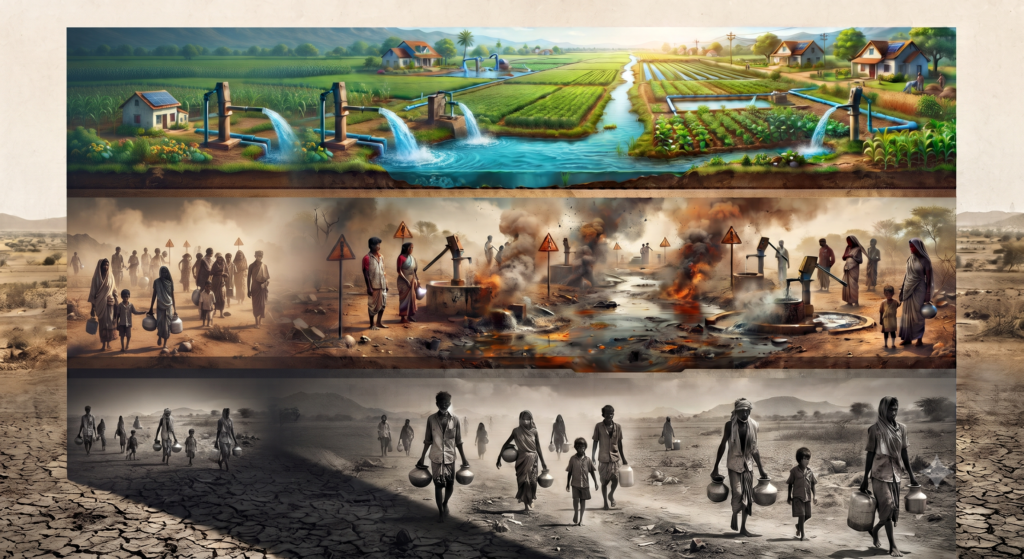
In North Gujarat, Dalit women wake before dawn to walk miles to collect drinking water in buckets, passing tubewells owned by upper-caste farmers just metres from their homes. They cannot access these wells because they do not own the land beneath them. Under India’s 1882 Indian Easement Act, a colonial statute predating independence by seven decades, groundwater rights are inseparable from land ownership. Landless people have no legal entitlement to groundwater, regardless of how contaminated or depleted public sources become.
More than 30 per cent of India’s population owns no land. These landless populations are tenant farmers, agricultural labourers, and urban poor, disproportionately from Dalit, Adivasi, and lower-caste communities. Scholars now describe this system as “Environmental Casteism”: the intersection of caste-based discrimination and environmental injustice, where ecological crises weaponise caste hierarchies.
The groundwater crisis India’s media covers depletion, contamination, subsidence, agricultural stress is real and catastrophic. But it obscures a deeper injustice: access to water in India is determined by caste, class and land ownership, not by human need or constitutional right.
The Architecture of Exclusion
The Indian Easement Act of 1882 gives landowners the right to “collect and dispose” of all water beneath their land within their own limits. This provision, drafted during British colonial rule when land ownership itself was stratified by caste, embedded caste inequality into India’s water law. Independent India never replaced it.
Constitutional scholars argue that Article 21 of the Indian Constitution the right to life encompasses the right to water. Yet the Supreme Court’s public trust doctrine, requiring that crucial resources be available to everyone equitably regardless of socio-economic criteria, has not translated into groundwater law. The 1882 law creates what legal scholars call “direct conflict” between constitutional principle and statutory practice.
India’s Model Groundwater Bills, first proposed in the 1970s, perpetuate the same land-based hierarchy. Each revised version, including the 2017 Model Groundwater Bill, maintains the direct link between landowners and groundwater rights, leaving landless people excluded.
As a result, groundwater governance ensures “neither equity nor sustainability,” according to water law experts. Instead, it crystallises caste and class advantage into water law.
The Rise of the “Water Lords”
In North Gujarat and across semi-arid western India, upper-caste landowners have become what communities call “Water Lords” individuals who own land, own the tubewells beneath it, and by law, own all groundwater rights. The proliferation of tubewells over four decades has amplified their power.
These Water Lords extract groundwater for irrigation, livestock, personal use and commercial purposes, all legal under the 1882 law. Neighbouring Dalit and Adivasi communities, unable to own land, depend on public water structures or rainwater harvesting. But public structures are themselves sites of caste discrimination. About 71 per cent of Dalit settlements in Gujarat villages have no access to public water supplies. When water is accessible, upper-caste people control who can draw it and when, enforcing untouchability norms that bar Dalits from using shared wells.
This system operates across India but is most visible in semi-arid regions dependent on groundwater. In North Gujarat, a community’s socio-economic status determines its water access. Upper-caste landowners use more water than anyone else for irrigation of cash crops, livestock, and agricultural processing. Lower-caste landless populations use minimal water for survival. Yet the law protects the excessive use of the powerful and excludes the minimal claim of the powerless.
When Depletion Becomes Discrimination
As groundwater depletes, the hierarchy intensifies. Satellite data show Eastern Uttar Pradesh sinking at 7 centimetres yearly and Punjab at 46 centimetres yearly. Water Lords with deep tubewells and capital to drill deeper can access retreating aquifers. Dalit and Adivasi communities, dependent on shallow hand pumps and public wells, lose access entirely.
In Jafrabad district in Gujarat, where coastal intrusion has contaminated groundwater, wells are already undrinkable. Dalit women are forced to walk miles to fetch safe water, exposing them to extreme precarity and vulnerability to sexual assault by upper-caste men. Meanwhile, Water Lords’ irrigated fields, powered by subsidised electricity, continue producing surplus crops from extracted groundwater.
The contamination layer amplifies this injustice. Scientific research shows 80 million people exposed to arsenic above safe limits and 411 million in fluoride-contaminated districts. But these figures obscure a distribution pattern: contamination affects the poorest most severely because they have no choice in water source. Water Lords can invest in filtration, purchase tanker water, and access multiple sources. Landless Dalit families accept contaminated well water or walk kilometres for it.
The Legal Invisibility
India’s Central Ground Water Authority regulates only 162 critical or over-exploited areas out of 6,746 total assessment units. Where the CGWA does intervene, regulations restrict extraction but do not address the caste dimension of groundwater rights. No assessment unit has implemented regulation that separates groundwater rights from land ownership. The National Water Policy omits any explicit recognition of rights for communities that do not own land.
This legal silence is not accidental. Attempts to reform have faced determined resistance. When decentralised water governance has been proposed in Gujarat, resistance from landowning communities has been fierce. Maintaining control of water access gives upper castes an economic and social advantage over lower-caste people. Reform would threaten this advantage. Therefore, resistance continues.
The Difficult Path: Tasgaon-Atpadi’s Ongoing Struggle
One rare example exists where the land-water nexus is being challenged: the Tembhu Lift Irrigation Scheme in Maharashtra’s Atpadi taluka. In 2014, the Maharashtra government agreed to implement equitable water distribution based on household rather than land ownership. This meant every household, including landless workers, would receive equal water rights for irrigation.
The scheme was restructured as a pilot project in 2018 across three talukas: Atpadi, Tasgaon and Sangola. After decades of drought, villages transformed from barren landscapes into productive farmland growing pomegranate, grapes, sugarcane, and tomato. Atpadi became the first taluka in the state to use closed pipelines instead of open canal systems, preventing water loss and ensuring equitable distribution.
Yet this success remains fragile and incomplete. As of 2023, the project is still “work in progress” with significant challenges. Documenting every single household accurately remains difficult, and frequent transfers of irrigation officers mean local knowledge is repeatedly lost. The model has not been replicated nationally.
The Cautionary Tale: Why Models Fail
Sukhomanjri in Haryana offers a cautionary example. In the 1980s, it became India’s first village to successfully implement equitable water resource management, where every household had rights to water regardless of land ownership. The model succeeded: crop yields doubled, milk production increased, and household income rose from Rs 10,000 per year to Rs 40,000 by 1999-2000.
But by 2017, the model had collapsed entirely. Three of four dams silted up, and a highway bypass project destroyed farmlands and water infrastructureThe Hill Resource Management Society, which earned Rs 1.7 lakh in 1996, had fallen to Rs 10,000 in 2016-17. Members stopped meeting. Groundwater levels plummeted again as people abandoned collective management and dug borewells. Farmers began paying neighbours Rs 50 per hour to buy water from private borewells instead of using the commons. Crop yields collapsed to 600 kg in 2016 from 4.2 million kg in 1999-2000.
Sukhomanjri’s failure reveals a critical truth: equitable models cannot survive without continuous legal, political and administrative support. Without legislation protecting the model, without trained personnel to manage systems, without government commitment to defend collective resources, models revert to private extraction and caste hierarchy.
The Constitutional Contradiction
India’s Constitution grants every person the right to life (Article 21), which courts have interpreted to include access to clean water. The Supreme Court has invoked the public trust doctrine, holding that crucial natural resources must be held in trust for public benefit, not private monopoly. Yet groundwater law remains rooted in private land rights, creating what legal scholars call a “severe consequence for equity.”
This contradiction exists because abolishing the groundwater-land nexus would require upending property relations and fundamentally challenging landowning classes’ economic advantage. Courts have found doctrine; governments have found political will lacking.
Legal scholar Philippe Cullet noted that even Model Bills designed to address groundwater sustainability “create a direct link between landowners and groundwater which leaves out landless people.” The bills “did not provide a basis for shaking the unsustainable and inequitable system of control over groundwater linked to land rights but simply added another layer of bureaucracy.”
The Historical Echoes
The discrimination is not new. In 1927, Dr. B.R. Ambedkar led the Mahad Satyagraha when Dalits gathered at Chavdar Lake in Maharashtra to assert their moral and legal right to access water and challenge discriminatory norms practiced by higher castes. Nearly a century later, the same norms persist in groundwater law.
What Remains Unacknowledged
Mainstream discourse on India’s groundwater crisis focuses on quantity (depletion), quality (contamination), and infrastructure (subsidence). Almost none addresses the fundamental fact: groundwater access in India is governed by caste and land ownership, not by need or constitutional right. A 2018 NITI Aayog report states that India ranks 120 of 122 countries in the Global Water Quality Index. Yet this report does not disaggregate by caste, class or landlessness to show who suffers worst from that low rank.
The National Water Policy lists priorities: drinking water, irrigation, hydropower, industry. It omits clarity on groundwater rights for landless communities and complete recognition of community rights to manage water resources collectively.
Researchers documenting the crisis note that “India’s Adivasis and Dalits continue to struggle with the constraints posed by poverty, bureaucracy, and discrimination in their pursuit for water rights.” Yet these struggles remain invisible in government policy, in satellite data, in most academic literature.
The Convergence
When satellite data reveal depletion and epidemiological studies show contamination, they capture the magnitude of a crisis but not its architecture. GRACE satellites can measure how fast aquifers empty; they cannot measure how caste determines who suffers when that emptying accelerates. Health studies document that infants face highest risk from fluoride and arsenic but often do not document that Dalit and Adivasi infants, denied access to public water supplies, face that risk at disproportionate rates.
The crisis and the injustice are the same crisis viewed through different lenses. Groundwater depletion is real; it is also shaped by who has rights to extract it. Contamination is real; it is also concentrated in communities legally excluded from alternatives. Subsidence is real; it compounds the vulnerability of societies already excluded from water law.
India’s groundwater crisis cannot be solved without solving its water apartheid. No amount of water conservation, no technological innovation, no rainfall harvesting scheme will deliver equity to the 30 per cent of Indians who own no land and have no legal right to groundwater. Reform requires abolishing the 1882 law’s land-water nexus and creating statutory frameworks that delink groundwater rights from land ownership.
For now, the Water Lords continue extracting from depleting aquifers. The Dalit woman continues walking miles for contaminated water. The satellite continues measuring the crisis. And the colonial law continues governing who belongs to water and who does not.