
13 October 2026
People Pen Desk
Bengal’s neighbourhoods took the goddess out of the zamindar’s courtyard and onto the street, turning a private ritual into a festival that belonged to every lane. The story of the first open puja on the Adi Ganga shows how this happened and why the community puja still shapes Bengal’s streets.
For generations, Durga Puja in Bengal was a private affair, held in the courtyards of landlord and merchant households, where only invited guests were admitted. Over the next century, neighbourhood groups broke that rule, and the goddess became a public festival that anyone could walk into.
A Puja for the Sahibs’ Eyes
Before the pandals came the bonedi bari pujas, held in the courtyards of old zamindar families, wealthy merchants and royal houses. Kolkata’s first Durga Puja is believed to have been held in 1610 by the Sabarna Roychowdhury family of Behala. The puja became fashionable among rich Calcutta families after 1757, when Naba Krishna Deb held a grand one at Sovabazar and invited Lord Clive and other Company officers, months after the Battle of Plassey.
Historian Tapan Raychaudhuri argued that for the new rich of the Company’s trade and land system, the puja was a place to display wealth and mix with the sahibs. The prize was to have the governor-general as chief guest. Even the immersion was a spectacle. Jawhar Sircar describes carts lit with lamps and resounding with the dhak, carrying idols to the Ganga, and idols taken out on twin boats that parted mid-river.
This grandeur came at a price. Families often kept people out on grounds of caste and money, and even invited guests could feel humiliated once inside. A puja for the common people was needed.
When Guptipara said “enough”
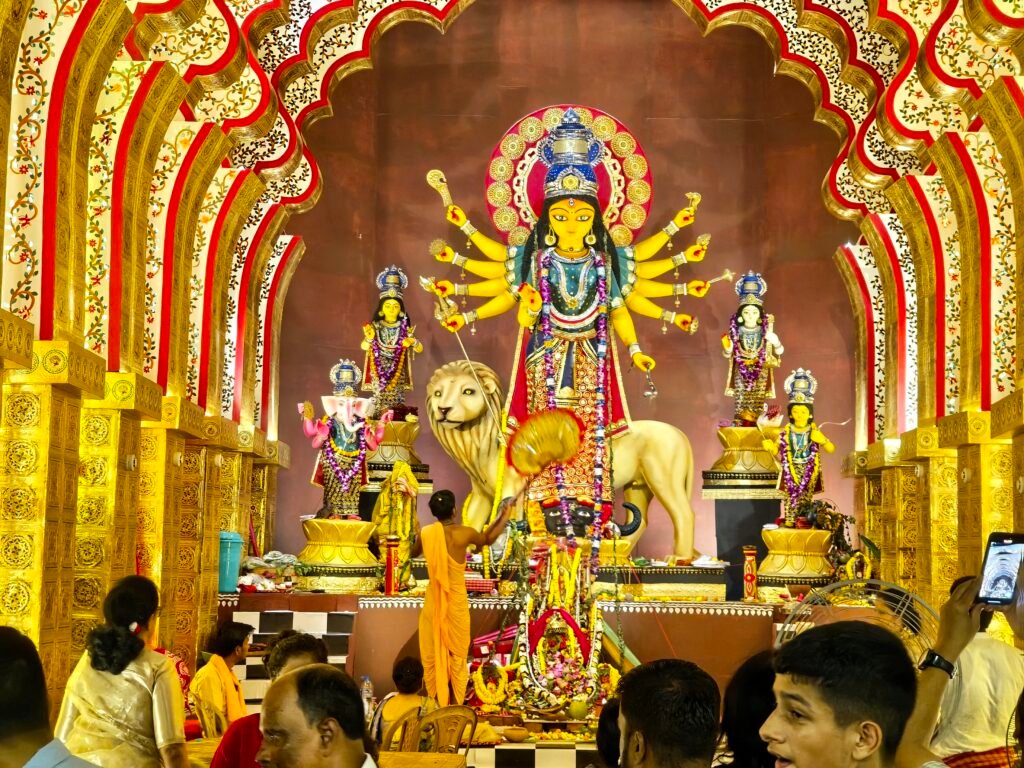
The story goes back to Guptipara, a village in Hooghly district. Village women went to pray at a zamindar’s house and were turned away, possibly because the family wanted the worship to remain within its own members. Twelve men of the village took the insult personally. If the big house would not share the goddess, they would bring her into the open so that everyone could pray. Hence the name barowari puja: baro means twelve and yari means friends. The word sarbojanin, which came into use later, means “for everyone”.
Chanda, from the start
The first organisers also set the pattern for chanda. They formed committees and collected subscriptions from nearby villages. When that fell short, they sent men to other parts of the country, and an 1820 newspaper report says many of them never returned. Later fundraisers were not always gentle. Samir Kumar Das and Bishnupriya Basak, in The Making of Goddess Durga in Bengal: Art, Heritage and the Public, write that in the nineteenth century, collectors pressed people for money almost like tax gatherers, while smoother talkers worked on rich households. The Depression of the late 1930s and early 1940s made the pujas depend even more on public money.

The First Open Puja on the Adi Ganga
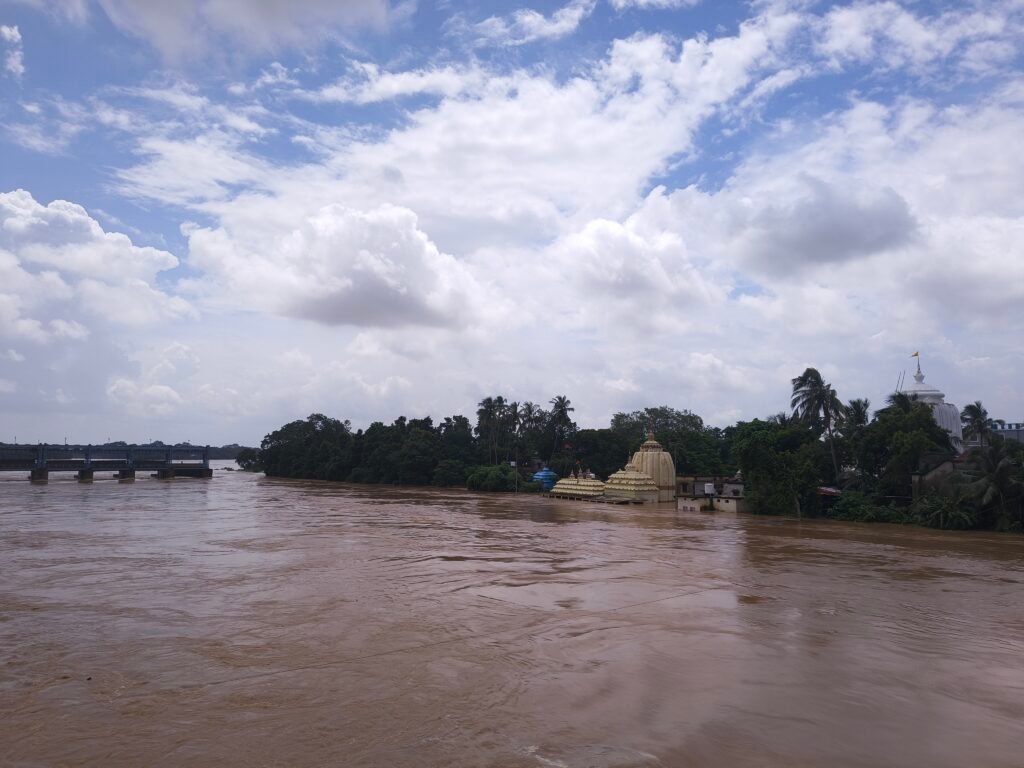
In 1910, the old Adi Ganga, known as Tolly’s Nullah, still flowed near Kalighat. On the bank off Balaram Bose Ghat, the Sanatan Dharmotsahini Sabha set up a Durga Puja that anyone could enter. This may well have been Calcutta’s first community Durga Puja, in Bhowanipore.
The first hurdle was the location. The ghat is about two kilometres from the Kalighat temple, and the area was once called Kali kshetra, the grounds of the goddess. Subhadeep Chatterjee, the Sabha’s secretary, recounts that the temple committee believed idols could not be worshipped there. Paintings on cloth or clay pots were allowed, but not a full murti. The patuas, the Kalighat painters who came from Midnapur and settled around the temple in the 1700s, lend some support to that view, though no record shows idol-makers living nearby.
The Sabha went ahead anyway. Its archives record that large religious organisations of the city agreed to a Durga Puja open to all, run strictly by Vedic rules. This meant many priests and a long list of rituals. The idol was placed beside the Jora Shib temple, facing it.
Others followed quickly. Between 1911 and 1926, several community pujas began across the city: Shyampukur Adi Sarbojonin (1911), Sikdar Bagan Sadharan Durgotsov in north Calcutta (1913), Adi Lake Pally in the south (1915), Sarkar Bagan Sammilita Sangha (1917), Bagbazar, then called Nebubagan (1919), Dharma Prasarini Samiti of Mukherjee Ghat in south Calcutta (1922), and Simla Byayam Samity (1926).

A festival with a political purpose
The timing was not accidental. Calcutta was to host the 26th session of the Indian National Congress in 1911. Historians Subhayu Chattopadhyay and Bipasha Raha write that this form of the puja served as a nationalist forum in religious guise. Jawhar Sircar notes that Calcutta was following the model of Bal Gangadhar Tilak’s large Ganpati celebrations in Maharashtra, which drew ordinary people towards the new politics. A crowd that came to see the goddess could also be organised for the freedom movement, and the colonial government had little reason to stop a religious festival.
Freedom fighters saw the opportunity. Netaji Subhas Chandra Bose and his elder brother Sarat Chandra Bose used community pujas to organise people and promote swadeshi, and most senior Congress leaders associated themselves with such pujas. Netaji presided over the committees of Simla Byayam Samiti, Bagbazar Sarbojonin, Kumartuli Sarbojonin, Adi Lake Pally and 47 Pally.
Simla Byayam Samiti shows how far this went. Its puja began in 1926 on the club’s own campus, and Bose inaugurated it. The idol was draped in khadi and came to be called the “swadeshi thakur”. The pandal held exhibitions of swadeshi goods and puppet shows that mocked British rule. From 1928, the puja added Beerashtami, a display of stick and sword fighting on Mahashtami staged by physical culture clubs set up by revolutionaries. After Independence, only the Bagbazar puja kept the tradition going, and it continued for decades until the COVID-19 pandemic halted it in 2020.

The para and the potter
A para is the Bengali word for neighbourhood, but it carries more than a location on a map. Its closest English equivalent is neighbourhood, yet a para has its own sports teams, its own pride and its own pandal. It usually has a club, a tea shop and a daily adda, and the pandal design is often debated in those sessions for months. A para also decides which households give chanda to which puja.
When Durga came out of the zamindar’s bari, she settled in the para. Every lane wanted its own goddess, and every para wanted hers to look better than the next. The first to benefit were the kumors, the clay artisans. Kumartuli in north Kolkata is considered the original centre for unbaked clay idols of Durga and other deities. The potters’ own quarter had a community puja too, and Netaji presided over its committee. Community pujas increased demand for these artisans and set neighbourhoods against each other over finer clay work. Kumartuli’s craft now faces market pressure and the departure of idol-makers. What was once a household need for the potter became a yearly contest between paras. Today, community pujas across Bengal are defined by bigger crowds, bigger pandals and louder publicity, along with the rivalry that comes with them. By the Adi Ganga, off Balaram Bose Ghat, the festival has changed far less than elsewhere in the city.