

5 October 2026 | 6 min read
Soumya Ranjan Bihara
Across India, over 40,000 food samples failed safety standards last year. Yet fewer than 2,000 prosecutions followed. When enforcement is optional, poisoning becomes permissible.
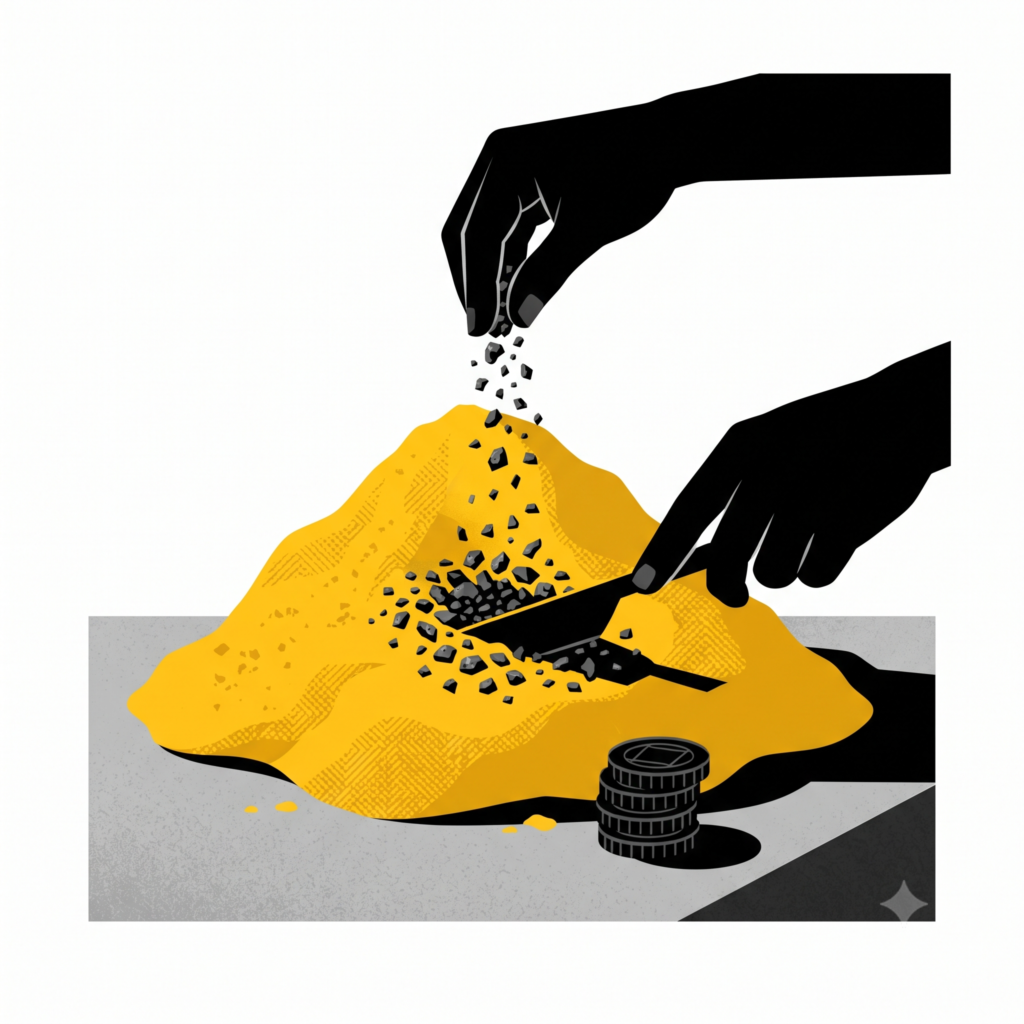
In kitchens across Bihar, families season their meals with gold dust they cannot see. Turmeric arrives as a bright powder, purchased in small bags from neighbourhood shops. What they cannot know without laboratory testing is that the spice carries an invisible cargo: lead compounds at dosages up to 640 times what government regulations permit.
India’s food safety failure is not a failure to monitor. The nation tests extensively, analyses obsessively, generates data relentlessly. What India has failed at is something more fundamental: using those findings to punish wrongdoing with any consistency.
Last fiscal year, food authorities screened more than 223,000 samples and documented nearly 41,000 instances of contamination, substandard composition, or misrepresentation. The testing capacity is formidable. Mobile laboratories roam the countryside, rapid-analysis kits sit in district offices, established labs operate routinely across state networks.
Yet barely 1,918 people facing criminal conviction in 2025-26 from 40,023 violations represents a ratio of prosecution to violation approaching 5 per cent. Stretch the view backward five years, and the criminal conviction rate collapses to around 3 per cent of all documented violations.
This asymmetry has consequences measured not in statistics but in damaged organs and eroded cognition.
When punishment arrives so infrequently that an adulterator can calculate it as a probable cost of business rather than a likely outcome, the incentive structure inverts. An entrepreneur adding lead chromate to turmeric invests approximately 100 to 400 rupees per kilogram in pigment. Since the product sells for substantially higher prices when made to appear premium, the profit incentive overwhelms honesty. In a food sector where eight out of every ten transactions occur in informal markets with thin margins and no organised regulation, this arithmetic overwhelms scruples.
The pattern across Indian states strips away any ambiguity. Tamil Nadu secured 857 convictions from 3,984 detected violations, a rate of one conviction per five violations. Bihar identified violations but brought no one to criminal trial. West Bengal, Telangana and Jharkhand replicated Bihar’s pattern. Uttar Pradesh and Rajasthan together account for roughly two-thirds of the nation’s violations yet secure only one-fifth of prosecutions. The system sends a simple message: violations incur vastly different penalties depending on geography.
The turmeric contamination in Bihar’s markets exposes why consequences matter. Researchers conducted systematic sampling of turmeric across 34 Bihari markets between 2021 and 2023, procuring samples directly from retail and wholesale vendors. When they tested samples for lead and related compounds, the results vindicated every trader’s worst nightmare and every regulator’s deepest anxiety. Throughout Bihar, every single market surveyed showed contamination with lead compounds. Three out of every ten samples failed to meet the 10-microgram limit India sets as law. The average turmeric carried 48 micrograms per gramme nearly quintupling the permissible dose. Some individual batches reached 6,416 micrograms per gramme, more than 640 times the safety limit.
The deliberate addition of lead chromate served two practical purposes. Research interviews with spice merchants exposed the economics driving the practice. Lead compounds brighten turmeric’s hue, making second-rate merchandise masquerade as premium stock and capture premium pricing. The same pigment also plugs holes from insect damage and deters future infestation, allowing stored inventory to persist longer without decay. The pigment itself costs virtually nothing traders procure it from hardware suppliers for between 100 and 400 rupees per kilogram. Economics rewards the practice.
But the price paid elsewhere is writ in cells and neurons. Lead damages virtually all tissues, showing particular cruelty toward developing brains and aging cardiovascular systems. In young people, the metal’s neurotoxic effects shrink intellectual potential that will never recover. In older populations, exposure correlates with hypertension, blocked arteries and early mortality. The damage progresses quietly across years, making causation difficult to establish and responsibility almost impossible to assign.
This concealment, the silent and delayed eruption of harm, explains why enforcement falters. Parliament’s auditing committee recently criticised the Food Safety Authority for a weak enforcement approach, noting the absence of any systematic national inspection system. The National Human Rights Commission, grappling with the scale of the crisis, convened a high-level meeting in April 2026 on tackling food adulteration. A stark problem emerged: cases filed under the Prevention of Food Adulteration Act, 1954, languish in courts for 15 years. By the time evidence reaches trial, it has become obsolete, rendering prosecutions weak even when violations are confirmed. This is enforcement failure made concrete proof that detection and prosecution have become entirely decoupled. Interviews with inspectors revealed a triage system shaped by telephone complaints and observable decay. Officers pursue cases involving rotten food or unhygienic preparation because the problems are tactile and correctable through immediate intervention. Lead exposure presents differently: no immediate injury, no visible symptom, no identifiable victim screaming for help. It belongs to the category of risks officialdom neglects.
Compounding this, India’s enforcement system is split across state lines. Each state maintains its own authority, answerable to state leadership and dependent on state resources. The central government prescribes standards; states enforce them. Food Authority teams manage thousands of commercial enterprises across multiple sectors, perpetually short of qualified staff and analytical equipment. Confirming lead contamination through testing consumes both rupees and time; weeks elapse before results arrive. Most inspectors lack specialised knowledge about lead’s comparative toxicity among food safety hazards.
Yet capacity is not destiny. Evidence from other nations demonstrates that determination shifts outcomes. Bangladesh confronted lead chromate adulteration beginning in 2019 by deploying targeted surveillance coupled with vigorous prosecution. Results came fast: within the first year, dangerous lead levels in turmeric fell by 90 per cent and the improvement has remained sustained since. Georgia pursued comparable supply-chain interventions with equivalent success. The Bangladesh effort expended under a million dollars: a pittance relative to populations protected.
The economic computation for India is inescapable. Researchers who modelled the consequences of ending lead chromate contamination in Bihar alone calculated annual gains ranging from 239 million to 1.6 billion American dollars stemming from improved child intellectual capacity and adult earning power. Add cardiovascular mortality reductions and the yearly benefit climbs to 430 million to 2.8 billion dollars. These tallies exclude kidney dysfunction, reproductive impairment and malignancy. They capture only the hardest, most demonstrable harms.
Yet India tolerates a system where this squandering continues, where documentation occurs without deterrence.
The state-by-state conviction divergence erases any pretence of inevitability. Enforcement is choice. Jurisdictions that convict at rates near 20 per cent function differently. They allot resources, expedite proceedings, relay an unmistakable signal that violations court danger.
A hidden problem hides within these statistics themselves. When authorities announce statistics (40,000 violations detected, 223,000 samples analysed), the public perceives reassurance. Newspapers praise enforcement actions. Policy makers cite the numbers as evidence of vigilance. But detection unaccompanied by prosecution is deception dressed as due diligence. The facade of oversight replaces actual oversight.
The choice India faces is whether contaminated food represents a national crisis demanding unified urgent action or a dispersed state-level management problem. Bihar’s data argues urgently for the former. Across the 34 sampled markets, an estimated 160 million residents encounter lead-contaminated turmeric routinely. Two groups suffer most from lead exposure. Children still developing their brains, and poor people living in malnourished regions, absorb lead most readily and face the worst damage.
Solutions exist within reach. Handheld fluorescence analysers deployed to markets could allow immediate removal of contaminated food without awaiting laboratory results. Education initiatives targeting traders, proven effective in Bangladesh and Georgia, could alter behaviour. Supply chain transparency systems obstruct adulteration. Yet none of this infrastructure matters if enforcement remains optional.
India faces an elementary question: Does testing 40,000 contaminated samples while prosecuting fewer than 2,000 violations constitute food safety, or just the appearance of safety? Can masses of laboratories and surveillance tools genuinely protect the public, or do they merely manufacture the appearance of protection?
The nation has moved beyond scarcity. Its harder test is ensuring fitness for consumption of what reaches the plate.