4 October 2026 | 8 min read
People Pen Desk
From priests and idol-makers to theme artists and organisers, women are taking charge of different parts of Kolkata’s Durga Puja, even as the craft remains largely male-dominated.
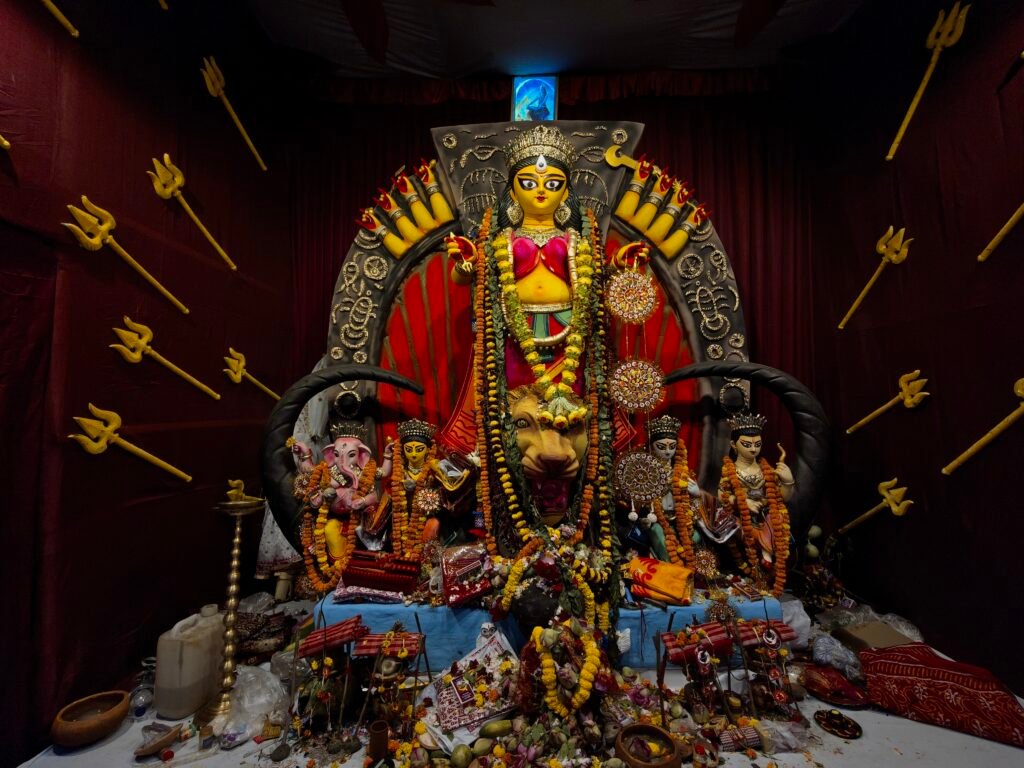
On October 10, 2026, Mahalaya will begin the countdown to another Durga Puja in Kolkata. The main festival days will run from October 16 to October 21.
But by then, much of the real work will be done. And increasingly, women are the ones who have done it.
Priests, theme artists, idol-makers, organisers, committee heads women now move through roles that, a decade ago, were almost always reserved for men. You see them in the pandal design studios of Kumartuli. You see them running community Pujas. You see them making decisions.
Yet walk into Kumartuli, the heart of Kolkata’s idol-making world, and you find the old story still holding. There are around 20 to 25 women among nearly 400 idol-makers. The numbers tell you how much has changed, and how much hasn’t.
The clearest numbers
By 2024, women were the principal theme artists for 14 major community Pujas in Kolkata. That was not a sudden shift. Since 2013, Aditi Chakraborty had been shaping Puja themes. Through the late 2010s, names like Tapashi Saha Chakraborty, Ankita Banerjee, Eshika Chandra and Priyanka Ghosh moved from assisting established artists often male family members to leading their own.
The work looks different now. Instead of standing beside someone else’s vision, many are setting the vision itself. A 2023 campaign featuring Aditi Chakraborty, Upasona Chatterjee, Suchana Samanta and Sumi Majumder put these sculptors at the centre of conversations about who makes Kolkata’s idols. The finished god or goddess in the pandal is what people see. The hands that shaped it, for years, remained unnamed.
Beyond the famous names
The most visible shift is in theme-making. But it is not the only one.
At Hindustan Park, a team of 25 women runs the Puja. At Golf Green, around 20 to 25 women chose the theme and built the main structure. At Sonagachi, women from the community started Durbar Durgotsab in 2013, and it runs still. Near Netaji Nagar, a Puja led by transgender women has operated for 10 years with a team of 50.
In Panchasayar, four women did something different. They revived a home Puja that had stopped nearly a century before. The wooden idol was 300 years old. They brought it back in 2022 and do not immerse it- it stays, year to year.
These examples matter because they show different kinds of work. One group enters the art economy, competing for commissions. Another runs the rituals. Another rebuilds what had been abandoned. Another creates something new from collective will.
The priesthood changed too
In 2021, at 66 Pally in south Kolkata, four women conducted an entire Durga Puja for the first time. Dr. Nandini Bhowmick, a Sanskrit scholar and Indologist, alongside Ruma, Semanto and Poulomi. None had performed a Durga Puja before. The committee had lost its longtime male priest and decided to try something different.
Dr. Bhowmick had been teaching Sanskrit at Jadavpur University, translating mantras into Bengali and English for weddings and smaller rituals. The committee found her through a film made about her work. They called their Puja Mayer Haate Mayer Abahon– Mother worshipped by mothers.
By 2024, Shubhamastu, the group Dr. Bhowmick founded, was working with five Durga Pujas. The growth showed something larger than one committee’s choice. It showed women moving into ritual space that had almost always belonged to men.
When UNESCO inscribed Kolkata’s Durga Puja on its list of Intangible Cultural Heritage in 2021, it specifically noted women’s role in keeping the festival alive. That was not a statement that gender equality had arrived. It was recognition that the festival’s survival now rested on people outside the old order.
Kumartuli: The story that does not change
Walk into the workshops of Kumartuli and the picture shifts.
Women are making idols. Some learned through family. Others came in after a husband or father died. Some inherited the skill but fought for workspace and money. A few struggled against men who did not want them there.
There are about 20 to 25 women among nearly 400 idol-makers. That is progress. It is also a measure of how much of this ancient craft still belongs to men.
From helping to leading
There is a pattern running through the women’s stories.
Many came into this work through family ties a father, a husband, a father-in-law’s craft. Others assisted established male artists for years before being asked to lead alone. Now, increasingly, women are being commissioned for their own names.
That distinction matters. Helping is not the same as deciding. Several women are now shaping the artistic direction of major Pujas making the choice about what story the Puja will tell, which god will appear, what mood the space will hold.
The irony is sharp. The idol is what people come to see. The sculptor’s name often travels only in small circles. A Ponds campaign in 2023 tried to fix that by naming the artists making the idols. But that is still an exception, not the rule.
A puja built from savings
The story gets different outside Kolkata.
In Simlagarh village, Hooghly district, the Matrishakti Committee of women had run Kali Puja for years. They decided to do Durga Puja for the first time. No applications to officials. No loans. They took what arrived each month under the Annapurna Bhandar scheme money the government sends to women and pooled it. Month after month. They saved enough to build the festival themselves.
One village does not prove a pattern. Simlagarh is not Kolkata. But the story mattered because it was different. These women were not stepping into spaces made for them. They were building something of their own.
What we don’t know yet
There is no reliable count of how many women now work across Kolkata’s Puja economy at every level. The reporting that exists measures different things some count theme artists, others document committee heads, some profile individual sculptors. Those numbers cannot be added together into one figure.
Nor does growing visibility mean economic barriers have disappeared. Kumartuli’s numbers say the opposite. Women still make up a fraction of idol-makers. Some report problems with workshop space, with money to buy materials, with rising production costs.
The evidence also does not show that women-led Pujas are more sustainable, more democratic or more successful than those run by men. Each Puja is its own story.
The many hands behind the festival
Kolkata’s Durga Puja is not a single task. It is many.
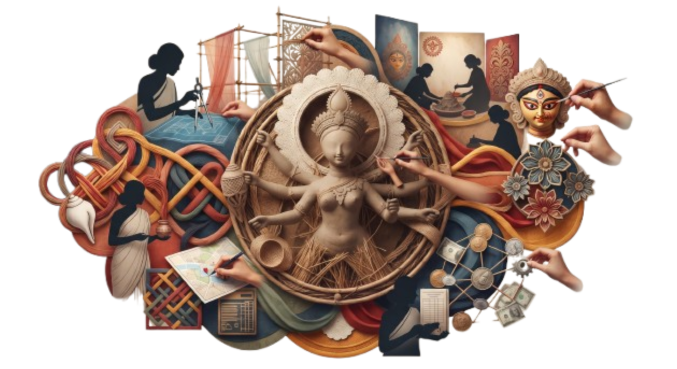
Someone chooses the theme. Someone shapes the clay. Someone paints the face. Someone builds the structure. Someone raises money. Someone runs the committee. Someone conducts the rituals. Someone manages safety and volunteers. Someone welcomes the crowds.
In recent years, women have entered several of these spaces. Not yet in equal numbers. Not in all of them. But they are there.
The larger shift may be this: women have moved from helping to deciding. They are not only preparing the festival. They are asking what it will be, who will perform it, how the work will happen, and sometimes, whether it will happen at all.
The measure that remains
Kolkata’s Puja has always been described through its idols, pandals, famous artists and crowds. Add to that picture now: the women whose names are being attached to the work itself.
The change is visible. It is also incomplete.
The real measure will not be how many women appear on Puja posters. It will be how many can enter the craft on equal terms, secure their own workspace, control their own decisions, earn from their work, and stay in the profession after the lights have gone dark.